
13.4 Regularization
Weight decay, dropout, and related controls on capacity.
These notes walk through the lecture slides. The original deck is unchanged; use (slides) on the course hub if you want that PDF.
Figures and notes follow Géron, Hands-On Machine Learning; Deisenroth, Faisal, and Ong, Mathematics for Machine Learning; and Theodoridis.
1. Why regularize
A deep net may have tens of thousands of parameters, sometimes millions. That freedom fits complicated data. It also overfits. You need regularization.
2. and (weight decay)
Both drop into backpropagation as a change to the loss. For ,
is the original loss. is the strength.
On the backward pass you add the gradient of that penalty to the gradient of . The update is ordinary descent on .
Effect: weights are shrunk toward zero. They cannot grow without bound. Larger means stronger shrinkage. This is weight decay: deterministic given .
3. Dropout
Hinton, 2012. At each training step, every neuron (inputs included, outputs never) is dropped with probability : ignored for that step, maybe present on the next. is the dropout rate, often 50%. After training, nothing is dropped.
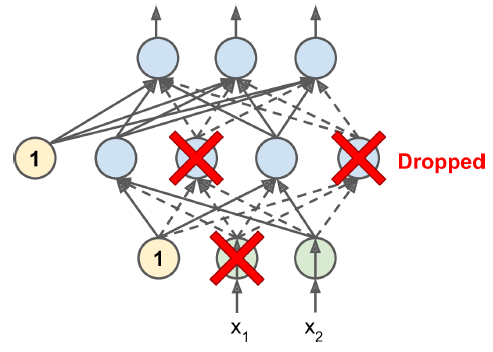
Overfitting: raise . Underfitting: lower . Large layers can take a higher rate than small ones. Many strong nets drop out only after the last hidden layer if full dropout is too strong.
Dropout slows convergence and usually improves the fitted model when is right.
4. Monte Carlo dropout
Gal and Ghahramani, 2016.
- A net with dropout before every weight layer is approximate Bayesian inference. That is a justification, not a slogan.
- MC dropout can improve a already-trained dropout model: no retraining, no architecture change.
- It also gives a better uncertainty estimate.
- It is simple to implement.
Practice
-
Dropout versus weight decay: which one is stochastic at train time?
-
In regularization, what does raising do to the weights?
-
You already trained a dropout net. What extra does MC dropout give you without a second training run?