
13.2 Self-Consistency and Tree-of-Thoughts
Majority vote +17.9 pp on GSM8K. Vote on answers, not wording.
These notes match the lecture slides. Use (slides) on the course hub for the deck.
One chain is a sample, not a proof. Self-consistency asks for several traces and votes. Tree-of-thoughts (ToT) searches among partial plans instead of committing to a single left-to-right story. By the end you should be able to run a majority vote on parsed answers, say why temperature 0 is not self-consistency, and contrast a tree with a tool loop.
1. What self-consistency and Tree-of-Thoughts are
Self-consistency (SC) is majority vote over several CoT traces. Sample traces (temperature ), parse an answer from each, and take the majority. The hope: wrong paths disagree; right paths land on the same number. Voting on the answer, not on the wording of the steps, is the usual rule.
Tree-of-Thoughts (ToT) is search among partial thoughts, not i.i.d. samples. A “thought” is a node: a subgoal, a candidate equation, a next move in a game. You expand a few children, score them (a prompt, a heuristic, or a checker), and keep a beam or run BFS/DFS. Greedy CoT is a tree of depth equal to one chain and width 1. ToT buys width.
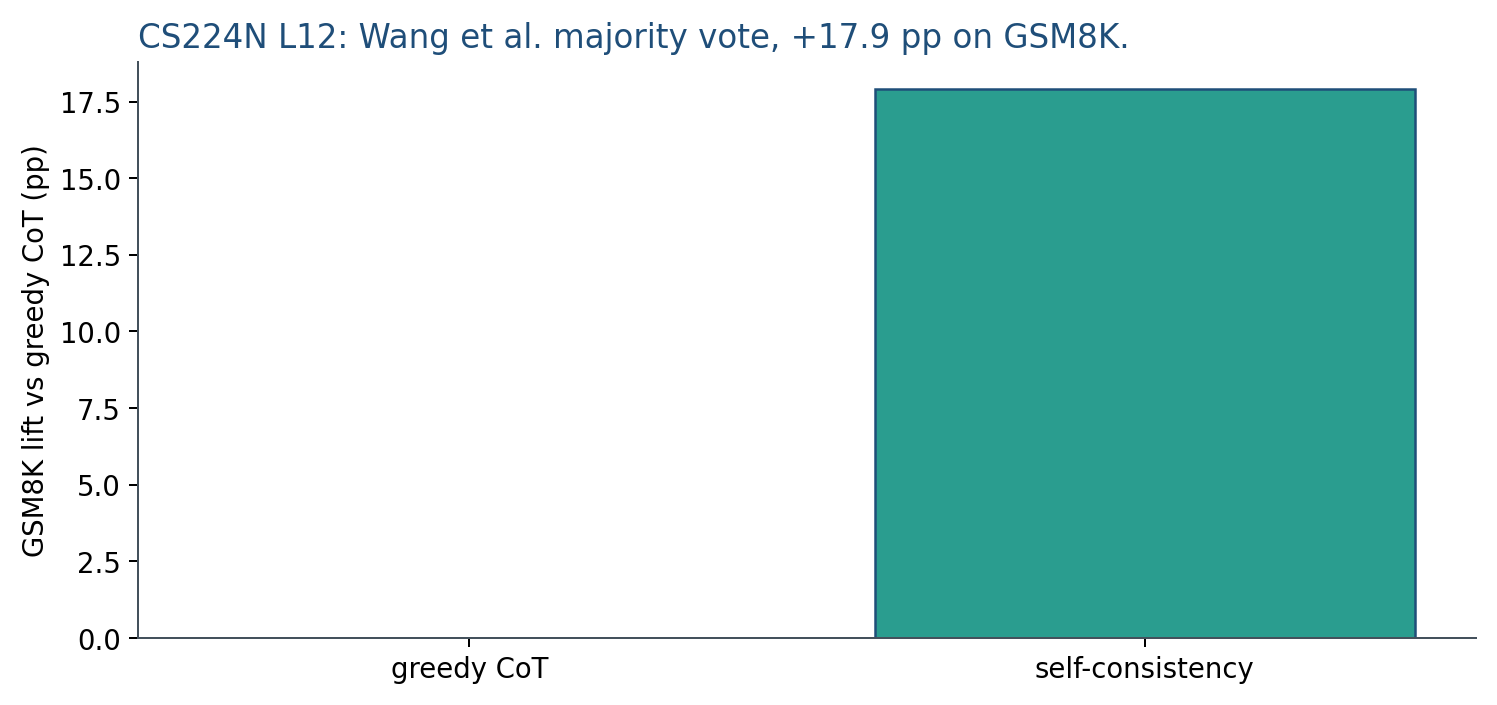
Temperature 0, is not SC: you will get identical greedy traces. Self-consistency does not fix a shared bug. If every trace uses the same wrong formula, the majority is still wrong. Wang et al. reported that majority vote raised GSM8K by +17.9 percentage points versus greedy CoT. That is a lift on the box. It is not a faithfulness claim (note 13.3).
This course’s version of extra test-time compute is traces. Do not assign DeepSeek-R1, GRPO, or a 256-expert run as homework.
2. Why we use it
One CoT is noisy. A single greedy chain can hit a digit bug and box 32 for . Sampling several traces and voting on the parsed number is a cheap noise reducer when errors are diverse.
ToT helps when you need a tree, not independent tapes. For , nodes “do multiply first” versus “do add first” can be scored before you decode a full wrong chain. ReAct (note 14.2) is a different control loop: the node can be a tool call, not only more text. Vote versus tree versus tools are three knobs. Do not mix the names in the report.
Always include a greedy CoT baseline at . Cost belongs in the table: tokens, or wall time on the hardware you used.
3. Architecture
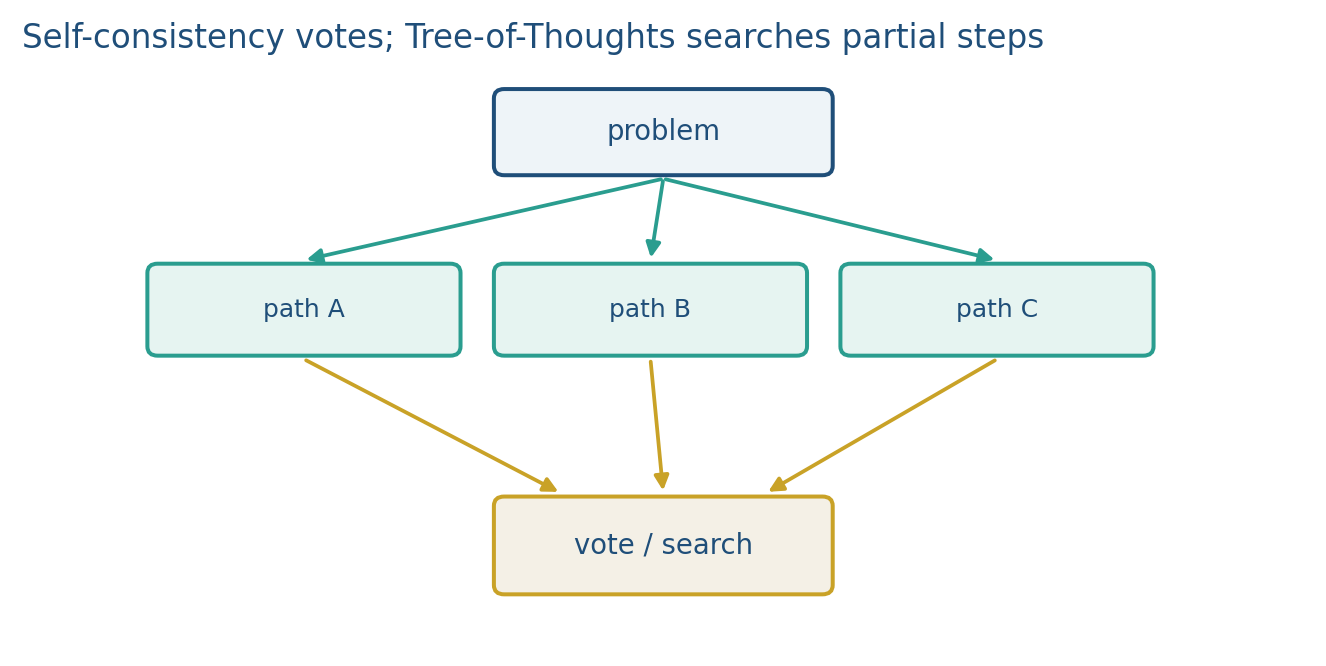
Self-consistency is a decoder plus a parser plus a vote. There is no new network. You pay forwards. Report and the parser (last integer, boxed span, regex). Lab 13 does that vote on constructed strings.
ToT is a frontier of partial strings, a scorer (LM or checker), and a search rule (beam / DFS / BFS). That is search with an LM as the proposal distribution. ToT has no single loss.
A cheap ToT scorer you can actually run in this course: last integer equals a known subgoal, a unit test, or calc from Week 14. An unconstrained “does this thought look good?” prompt is another noisy LM, not a checker.
4. How it works, step by step
Self-consistency.
- Use a CoT prompt from note 13.1. Set temperature so traces can disagree.
- Sample independent traces.
- Parse one answer from each (last integer, boxed span, or a regex). Do not vote on full step strings: different wording of the same algebra would split the vote.
- Take the majority. Write down a tie-break rule in advance.
- Plot accuracy against if you use this in a project; the curve usually flattens.
Tree-of-Thoughts.
- Represent a partial plan as a node (for example “multiply first” versus “add first”).
- Expand a few children from the frontier.
- Score them with a checker when you have one; prune the rest.
- Decode a full chain only along surviving branches.
Lab 13’s vote is the SC half: three constructed traces for , majority on the parsed number. The ToT cartoon in the worked example is search, not three i.i.d. tapes.
5. Mathematical formulas
Self-consistency parses each trace to an answer and takes the mode:
ToT has no single loss; it is search. Accuracy versus is the self-consistency plot. For ToT, accuracy versus expansion budget (nodes scored). Always include greedy CoT at .
6. Positive points and negative points
Positive.
- SC is simple: sample, parse, vote. Lab 13 can do it on constructed strings.
- Diverse errors cancel; a miss can become a majority hit.
- The GSM8K-style lift is a real box-accuracy result you can cite as motivation, not as a faithfulness claim.
- ToT can kill a wrong branch before you pay for a full chain, if the scorer is a checker.
Negative.
- Cost scales with (or with nodes scored).
- Shared bugs survive the vote: three copies of still vote 32.
- Temperature 0 produces identical traces, so is wasted.
- ToT needs a scorer; an unconstrained “looks good?” prompt is not a checker. The search math is not in this hour.
- ReAct (note 14.2) calls tools instead of searching thoughts. Mixing the names hides the knobs.
When not to. A lookup that does not benefit from extra traces. A task where you already have a calculator: call the tool (Week 14) instead of voting on invented arithmetic.
7. What to measure
Accuracy versus is the self-consistency plot. For ToT, accuracy versus expansion budget (nodes scored). Always include a greedy CoT baseline at . Cost belongs in the table: tokens, or wall time on the hardware you used.
8. Teaching this note
About 35 minutes at the board, then ~10 minutes of video. Self-consistency is the vote; the ToT paper is the search cartoon.
- 0–12 min. Temperature , traces, vote on the parsed answer. Tie-break rule.
- 12–22 min. ToT as width: expand, score, keep a beam. Contrast with ReAct (tools).
- 22–33 min. Worked majority vote on three traces (Lab 13 numbers).
- Then play Karpathy Deep Dive 1:46:56–2:01:11 (models need tokens to think). Pause on distributing hard work across tokens; then say: self-consistency is of those traces, ToT is a tree of them.
9. Worked example
Problem: , gold . Three traces, answers only (Lab 13 style):
| trace | parsed answer | steps (sketch) |
|---|---|---|
| A | , | |
| B | (digit bug) | |
| C | carry arithmetic to |
Vote on answers: . Majority is (2 of 3). using only B would have scored 32 and missed. Self-consistency caught the disagreement.
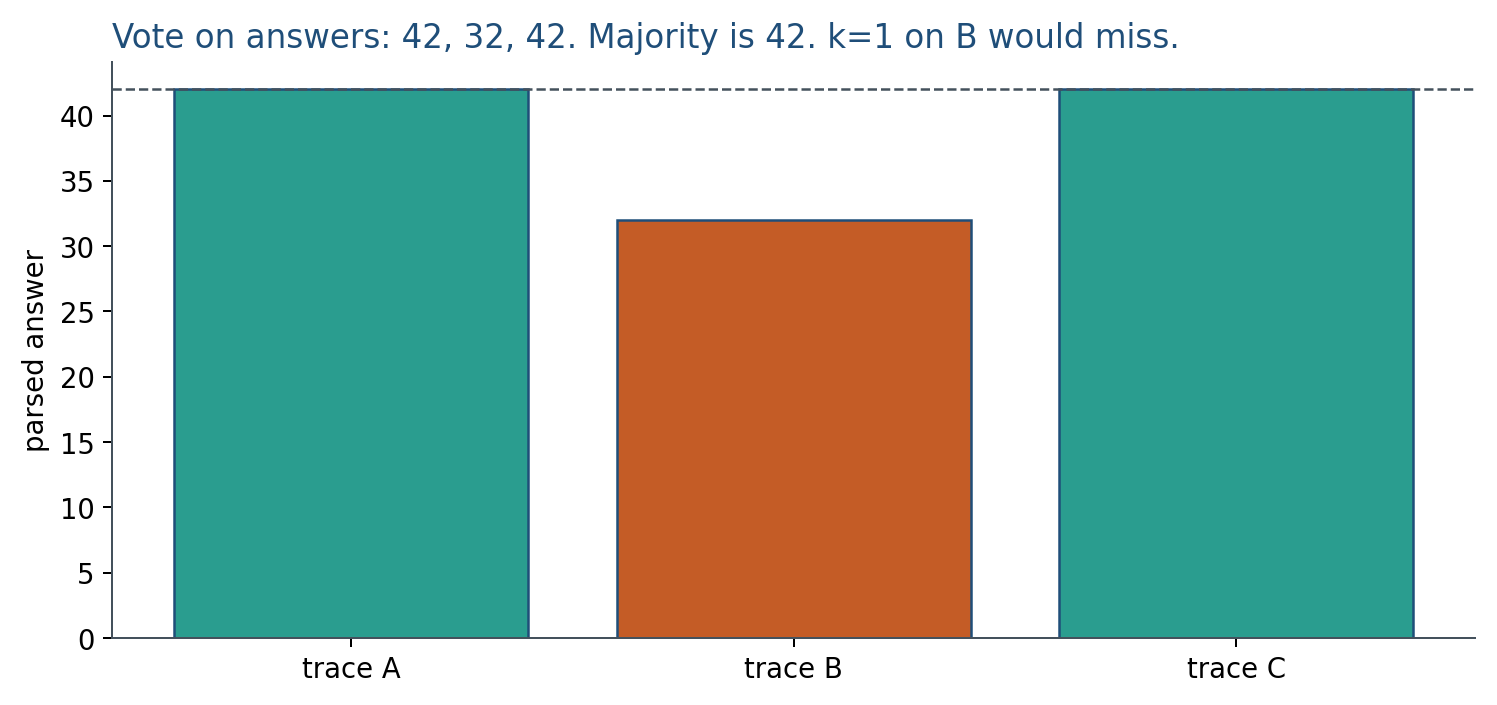
Tie example: answers . Majority is , which is wrong. Voting is not a proof; it is a noise reducer when errors are diverse.
Shared-bug example: all three use . Vote is 32. does not help. A checker (note 13.3, or a calc tool in Week 14) would.
ToT cartoon for : nodes “do multiply first” vs “do add first.” A cheap scorer (PEMDAS, or eval) kills the add-first branch before you decode a full wrong chain.
10. Where students get stuck
- Sampling at temperature and wondering why all traces match. You need diversity for a vote.
- Voting on the wording of the steps. Parse an answer; majority on that.
- Calling ToT “just CoT with more words.” ToT scores partial nodes and prunes.
11. Video
Watch Andrej Karpathy, Deep Dive into LLMs like ChatGPT, 1:46:56–2:01:11.
Pause on “models need tokens to think”: extra tokens are extra compute. This course’s self-consistency is independent traces plus a vote; ToT is search over partial thoughts. Optional: 2:14:42–2:27:47 (RL that explores many solutions) if you want a later-week bridge. Note 13.3 uses a different chapter of the same URL.
12. Practice
-
Why does self-consistency need temperature greater than 0?
-
Give one failure that majority vote cannot catch.
-
ToT scores partial thoughts. Why is a cheap checker (arithmetic, a unit test) a better scorer than another unconstrained prompt, when you have one?
-
Traces vote . What is the majority, and what is ? Gold is . Did vote beat a first-trace-only policy if the first trace was ?
-
Answers for . Write the vote. If you instead vote on full step strings (all different wording), what goes wrong?