
1.2 Neurons, Activations, and Feedforward Nets
A weighted sum, a nonlinearity, softmax, and an explicit two-ReLU XOR table.
These notes match the lecture slides. Use (slides) on the course hub for the deck.
A transformer is a large neural net. Before attention, you need one unit, a nonlinearity, and a stack of layers. By the end you should be able to write then , show that two linear layers collapse to one, and fill the XOR table with two ReLU units.
1. What a neuron is
A neuron is the unit of a neural net. It takes a vector , forms a weighted sum plus a bias, then applies a scalar nonlinearity :
is the pre-activation. is the activation. and are the parameters you will train. Stack many of these units, layer after layer, and you have a multi-layer perceptron (MLP).
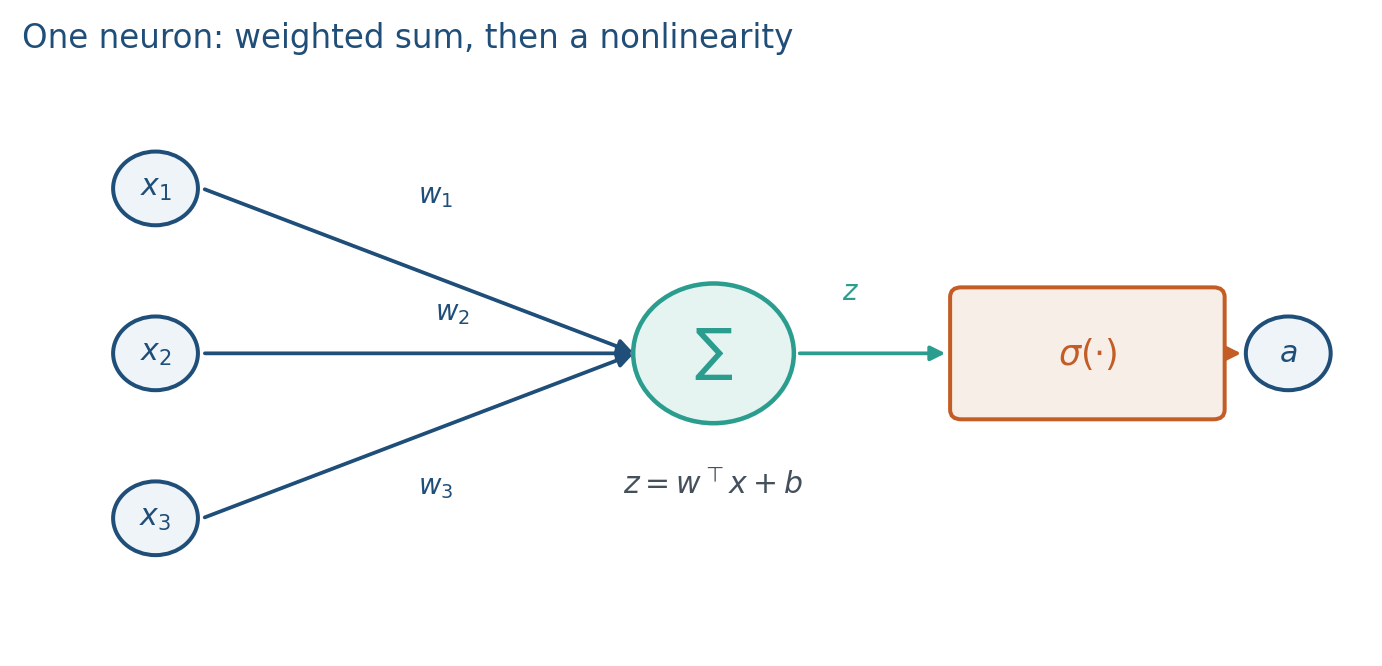
If is a step function, this is a 1950s perceptron. If is a sigmoid, it is logistic regression in one unit. Modern nets mostly use ReLU in hidden layers, tanh or GELU in some transformer blocks, and softmax on competing class scores.
On the board, always write and as two boxes. Students who skip cannot take derivatives next note.
2. Why we use it
A layer without is an affine map. Two affine maps compose to one affine map:
Stack as many linear layers as you want: you still have a linear classifier. The bend is the point of the hidden layer. Depth without a nonlinearity does not buy a richer function class.
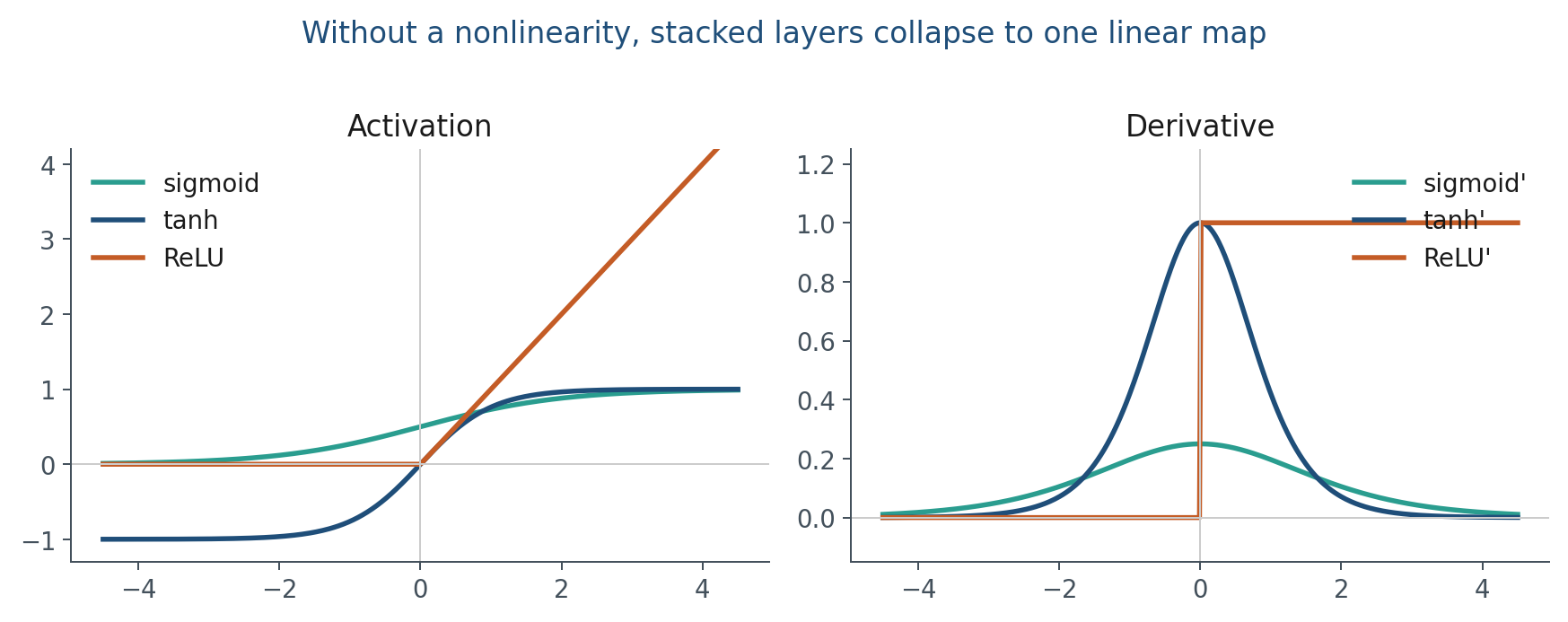
A single linear unit cannot separate XOR: the positive class is not on one side of a line. Two hidden units, then a linear output, can fold the space so the classes become linearly separable. That is the whole argument for depth, in miniature. Language models stack many such nonlinear maps (and, from Week 3, attention) so that “cat sat on the mat” and “the mat sat on the cat” do not look like the same vector.
GELU is a smooth cousin of ReLU; you will see it in transformer MLPs. You do not need its formula today. You do need: no bend no extra function class.
3. Architecture
The boxes connect in that order: input , then the pre-activation , then the activation . An MLP stacks that pattern layerwise. Layer sees the previous activations, not the raw input (except ):
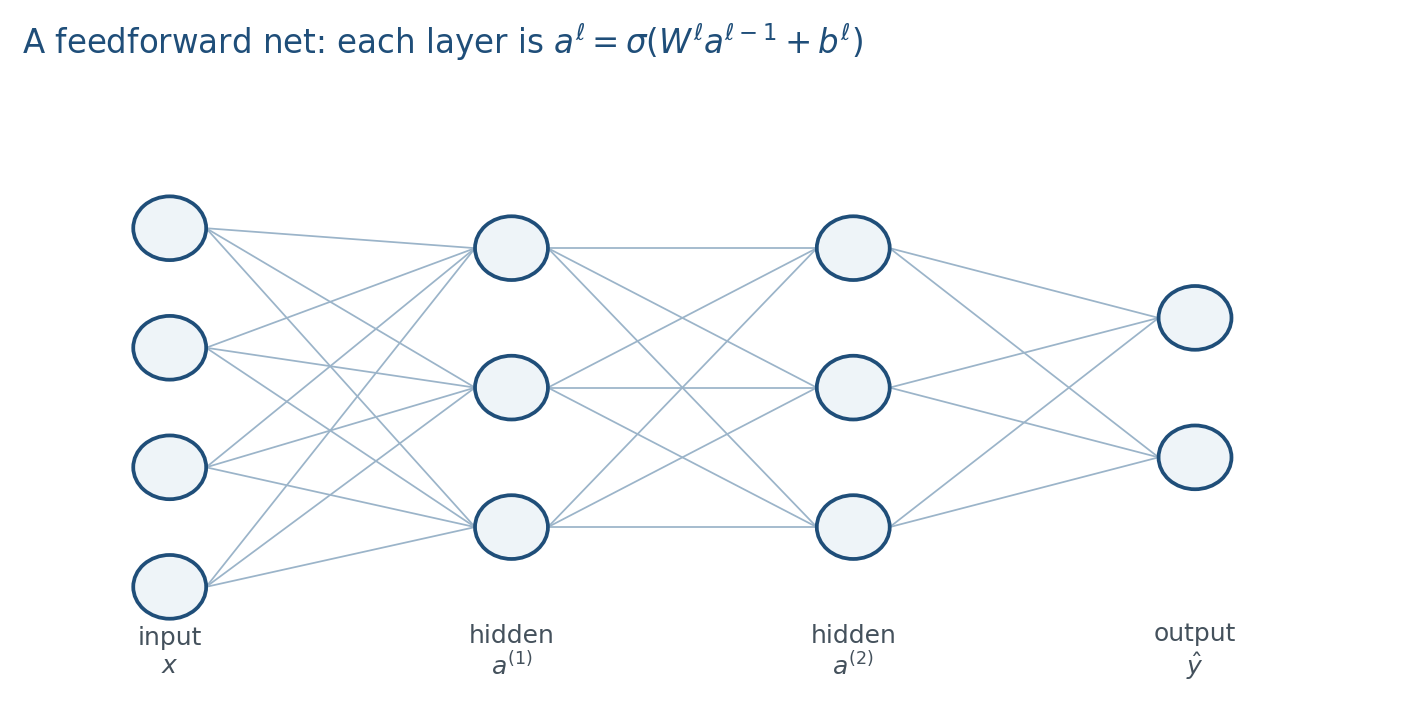
Every arrow in that picture is one entry of some . A “fully connected” layer means every unit in layer talks to every unit in layer .
A transformer block still contains an MLP; attention is extra mixing across positions. This note is the per-position map.
4. How it works, step by step
Pick for the job: ReLU in hidden layers, softmax when classes compete. Then run a forward pass and read the numbers. Training is the next note.
Goodfellow §6.1 writes an explicit two-ReLU solution for XOR. Hidden unit 1 is OR; hidden unit 2 is AND; the output subtracts:
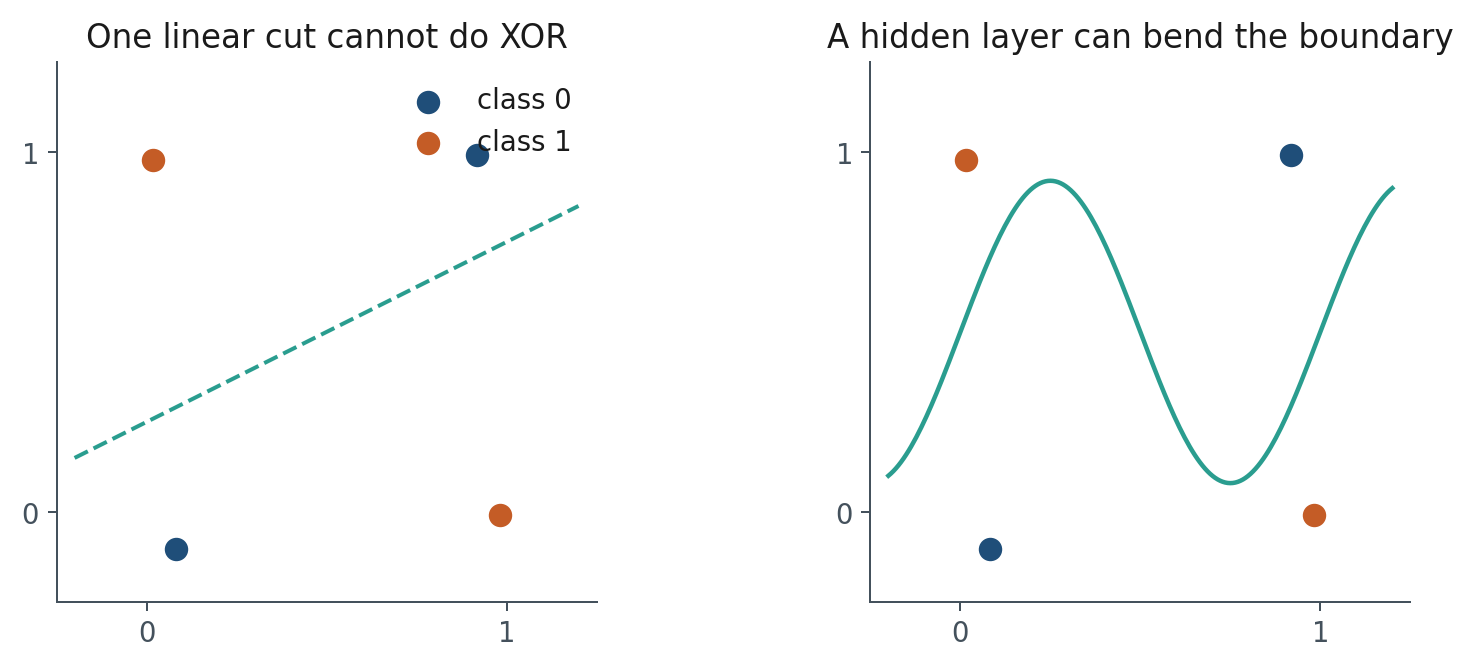
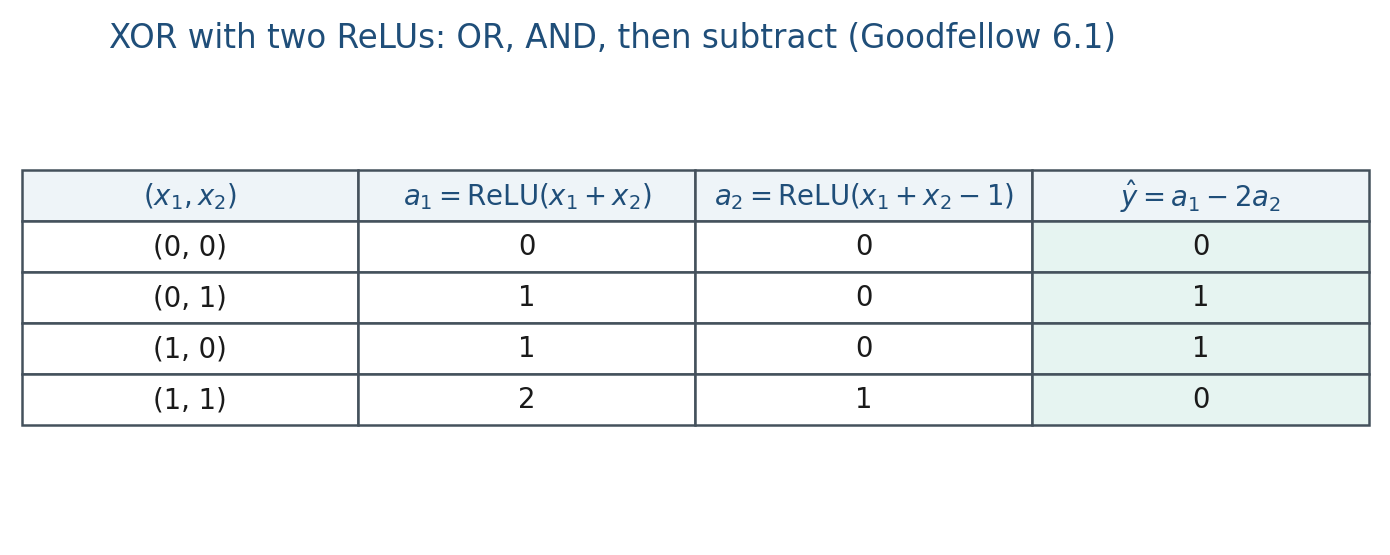
Check the four rows: , , , . That is XOR. The hidden layer folded the square so a linear output can finish the job.
Lab 1 trains a slightly larger net (Linear(2, 8) → ReLU → Linear(8, 1)) with autograd instead of these hand-chosen weights. Count the parameters before you run it:
- linear classifier
Linear(2, 1): parameters - Lab 1 MLP: plus = 33 parameters
Today you only need the forward pass on paper. Note 1.3 writes the backward pass for one ReLU unit.
5. Mathematical formulas
Write the three formulas you will actually use. Sigmoid (one independent Bernoulli):
Rectified linear unit, and its derivative (almost everywhere):
At the derivative is undefined; PyTorch uses 0. You will need in note 1.3’s chain rule.
Softmax turns a vector of scores into a distribution (mutually exclusive classes, or next-token / skip-gram):
That is the definition. We do not need the Jacobian this week.
The neuron itself is and . A stack without collapses to one affine map, as in section 2. A stack with is the layerwise recurrence in section 3.
6. Positive points and negative points
Positive.
- ReLU is cheap to compute and sparse: negative pre-activations become 0, so many hidden units stay off.
- Softmax gives a probability distribution over competing classes, which is the right object for next-token prediction.
- A small nonlinear hidden layer already buys XOR, which a linear classifier cannot do.
- The same unit is the per-position map inside a transformer MLP, so this note is not a toy you throw away.
Negative.
- Sigmoid saturates: its derivative is near 0 for large , which will matter when we talk about vanishing gradients in Week 2.
- ReLU’s zero derivative on the negative half-line is sparsity and a failure mode (dead ReLUs that never turn back on).
- No nonlinearity means no extra function class, no matter how many layers you stack.
- At , is undefined; frameworks pick a convention (PyTorch uses 0), so you should not pretend the derivative exists everywhere.
When not to use a deep stack of these units alone. Order in a sentence is not a bag of independent neurons. Sequence models (Week 2) and attention (Week 3) mix across positions. This note is the per-position nonlinearity.
7. Teaching this note
~16 minutes at the board in the shared two-hour meeting. Derive one neuron ( then ), write sigmoid / ReLU / / softmax, then the two-linear-layers collapse, then the XOR table. Do the numeric ReLU on/off example before any video. 3Blue1Brown is homework, not this block: 2:42–11:34 (neurons, layers, why layers, edge detectors). Lab 1 is the studio follow-up after note 1.4.
8. Worked example
Take , , .
Change the second coordinate to : , so . The unit is off; its local derivative is 0.
Now drop and compose two layers in 1-D: , , , . The map is , still a line. Write that product on the board before you fill the XOR table.
Softmax check (three logits): . Then , sum , so . The largest logit gets the largest probability; none is 0.
9. Where students get stuck
- Mixing up and , then trying to backprop through the wrong box.
- Believing “more layers” automatically buy a richer model even with no .
- Treating ReLU’s zero derivative as only a bug (it is also sparsity) or only a feature (dead ReLUs).
10. Video
Watch 3Blue1Brown: But what is a neural network? as homework.
Pause at 2:42 (a neuron as a number), 5:31 (why layers), 8:38 (edge detection as a hidden feature), and 17:03 (ReLU vs. sigmoid). The digit-classifier story is the intuition; our algebra is then .
11. Practice
-
Write for a two-hidden-layer net as a nested formula in and .
-
Drop every . What class of functions remains?
-
Why is ReLU’s derivative 0 on the negative half-line a feature and a failure mode?
-
For , , , compute and . Then compute to two decimals. Which unit is closer to “off”?
-
Let , , both biases zero, no . Write the composed map as a single row times .
-
Using the XOR weights in the table, compute for . Then count parameters in Lab 1’s MLP
Linear(2, 8)→ ReLU →Linear(8, 1).