
3.4 GPT and BERT
Same block. Causal next-token versus masked tokens. Contextual, not a static table.
These notes match the lecture slides. Use (slides) on the course hub for the deck.
GPT and BERT are the same block with different masks and objectives. That choice is the difference between a generator and a bidirectional encoder. The fork is the objective: causal language modeling versus masked language modeling. By the end you should be able to fill the objective table, mask a score matrix, and say why BERT cannot stream tokens.
1. What GPT and BERT are
GPT and BERT are two uses of the same transformer block. GPT: causal next-token (left to right). BERT: masked tokens, bidirectional context. Both produce contextual vectors, not a static table (Week 1).
Week 1’s embedding table gave bank one vector. A transformer gives bank a vector that depends on the sentence: river bank versus money bank. That is a contextual representation. ELMo did this with LSTMs; GPT and BERT do it with the Week 3 block.
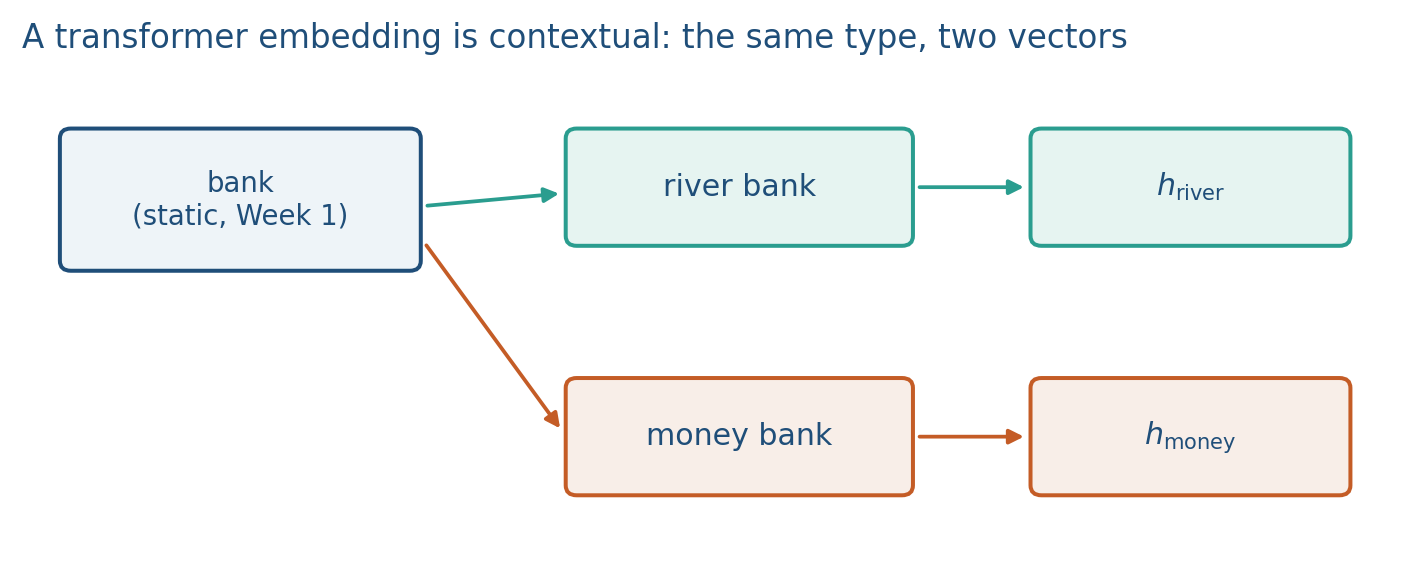
“Transformer” is the block. GPT/BERT is the objective. Calling every transformer “a GPT” erases that fork.
2. Why we use it
Language modeling (GPT) is the pretrain that later becomes ChatGPT. BERT-style MLM is a bidirectional encoder for classification and span tasks.
Pretrain once on unlabeled text, then fine-tune a small head (or the whole stack) on a labeled task. Pretrain once, fine-tune many times.
The same block, bigger: more layers, wider , more heads, more data. Week 7 is scaling laws and efficiency. This week: if the mask is causal, you have a language model; if not, you have a contextual encoder.
For the project: generation, RAG, and tool-use sit on a decoder. Classification into a small label set can still use an encoder, or a decoder with a prompt.
Do not fine-tune BERT as if it were GPT. A [MASK] model is not a chat decoder. You can classify with a decoder via a prompt; you cannot stream tokens from BERT without a separate head.
3. Architecture
Same transformer block as note 3.3. GPT masks the future. BERT masks random token ids and reconstructs them. Heads differ (LM versus CLS/span).
GPT (decoder-only): each token may attend to itself and the past. The pretraining job is next-token (causal language modeling). Sampling is ancestral: emit , then condition on it.
BERT (encoder-only): every token may attend to every token. The pretraining job is masked language modeling (and originally next-sentence prediction; later work often drops NSP). You cannot sample a paragraph left-to-right without extra machinery.
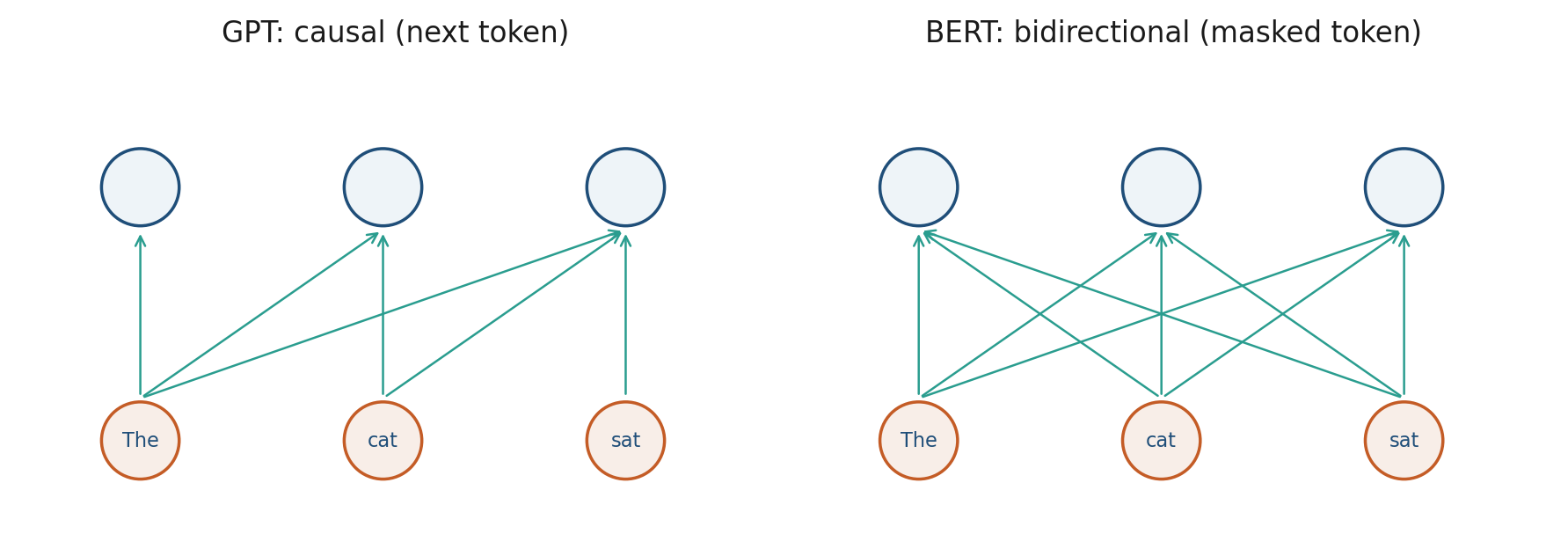
Causal mask: a lower-triangular pattern of legal scores. BERT’s “mask” is a token [MASK] in the input, not a future-key mask. Those two uses of the word confuse people all semester.
![Next-token versus [MASK]](files/graphics/3.4-gpt-bert/mlm-clm.png)
| GPT | BERT | |
|---|---|---|
| Stack | decoder | encoder |
| Mask | causal | none on keys (random tokens hidden) |
| Loss | ||
| Default use | generate, chat, complete | classify, tag, embed a span |
| Peek at the future? | no | yes, by design |
Modern “BERT-like” encoders (RoBERTa, embedding models) keep the bidirectional idea. Modern LLMs are GPT-style stacks, often with extra alignment (Weeks 8–9). Encoder–decoder models (T5, BART) exist; they are the original transformer, not a third mystery architecture.
BERT-base, one line: , , 12 heads, about 110M parameters. GPT-1 was the same size on a decoder. The fork is the mask and the loss, not the width.
4. How it works, step by step
Train on unlabeled text. After pretrain, GPT generates; BERT is usually fine-tuned with a small head.
GPT path.
- Embed tokens and add positions. Apply a causal mask so token cannot see .
- The loss is next-token NLL: at each position (teacher forcing, as in the RNN-LM).
- At generation time, sample , append it, and continue. That is ancestral sampling.
BERT path.
- Hide a random subset of token ids (classically about 15%) by replacing them with
[MASK](and some random / keep-id noise in the original recipe). - Every token may attend to every token. There is no future-key mask.
- The loss reconstructs the masked positions, , not a full joint factorization of the sentence.
- Downstream, add a small head on
[CLS]or on token states and fine-tune.
Masking GPT scores with instead of is the same bug as Lab 3: softmax still puts mass on the illegal key.
5. Mathematical formulas
GPT factorizes the sentence left to right:
BERT reconstructs masked positions, not a full joint factorization:
A causal mask sets illegal future scores to before the softmax, so those probabilities are 0. BERT has no such triangular mask; its [MASK] is an input token.
Worked scores live in the example below; the algebra is row-wise softmax on the (possibly masked) score matrix.
6. Positive points and negative points
Positive.
- Contextual geometry: bank in “river bank” is not the same vector as bank in “money bank.”
- One block, two objectives: you reuse note 3.3 and only change the mask and the loss.
- GPT is the default stack for generation, RAG, and tool-use in this course.
- BERT-style encoders remain a strong default for classify / tag / embed-a-span when you do not need to stream tokens.
- Pretrain once, fine-tune many times, on unlabeled text then a small labeled head.
Negative.
- GPT cannot see the future inside a prompt token; a bidirectional encoder can, by design.
- BERT is not a natural generator. You cannot stream tokens from it without a separate head.
[MASK]is not the same object as a causal key mask; mixing those words lasts all semester.- Calling every transformer “a GPT” hides the objective fork.
- Masking GPT scores with instead of lets probability leak to the future.
When not to. If the demo must stream tokens, BERT is the wrong pretrained model. If you only need a small label set and full-sentence context, a decoder is optional, not mandatory.
7. Teaching this note
~16 minutes. Static vs contextual bank, then the two attention triangles, then the objective table, then the causal-softmax example. Play Karpathy Let’s build GPT 0:00–12:00 (tokens in, next token out). Then 0:00–8:00 of CodeEmporium BERT (MLM / [MASK]). If you only have one clip, keep Karpathy and assign BERT.
8. Worked example
Two tokens, raw scores .
GPT (causal): illegal future is . Set it to :
Softmax row 1: . Row 2: because , .
BERT (bidirectional): softmax both rows of the original . Row 1: . Token 1 does look at token 2.
Objective contrast: GPT loss on this pair is . BERT, if token 1 is [MASK], is (and any other masked sites).
9. Where students get stuck
- Using BERT when the demo must stream tokens.
- Masking GPT scores with instead of .
- Calling every transformer “a GPT.”
- Thinking
[MASK]is the same object as a causal key mask.
10. Video
Watch Karpathy: Let’s build GPT through the first attention / causal-mask implementation (start 0:00–12:00 in class; the attention code is later if you assign homework).
Also CodeEmporium: BERT Neural Network — EXPLAINED!. Pause on masked language modeling and next-sentence prediction. You do not need to train BERT today.
11. Practice
-
Why is BERT the wrong pretrained model if your demo must stream tokens?
-
A sentiment classifier: encoder or decoder? Give one reason for each.
-
What does a causal mask set the illegal scores to before the softmax, and why not zero?
-
Scores , causal mask. Write . (Uniform among legal keys.)
-
BERT hides 15% of tokens. In a sequence of length , how many tokens are masked in expectation? If the loss is only on those positions, how many terms enter the mean that step?
-
bank in “river bank” versus “money bank”: what did Week 1’s table do, and what does BERT do?
-
Name one encoder-only, one decoder-only, and one encoder–decoder model. Which one is the default stack for this course’s generation projects?