
1.4 Word Embeddings and Semantic Geometry
Dense vectors from a corpus window, skip-gram softmax, analogies, and a signed-projection bias probe.
These notes match the lecture slides. Use (slides) on the course hub for the deck.
A language model does not read characters as characters. It reads vectors. This week those vectors are word embeddings. From Week 3 they are token embeddings inside a transformer. The geometry is the same idea. By the end you should be able to write skip-gram’s softmax, compute a cosine, and run Lab 1’s occupation probe.
1. What an embedding is
An embedding is a map from a token id to a dense vector. Give each word its own one-hot coordinate and film and movie are orthogonal: inner product 0. The vector is sparse, as long as the vocabulary, and a new word has no coordinate at all.
A distributed representation is short and dense (50–300 dimensions is a classical size; transformer hidden sizes are larger). Meaning is spread across coordinates. Similar usage produces nearby vectors. That is the geometry you can learn.
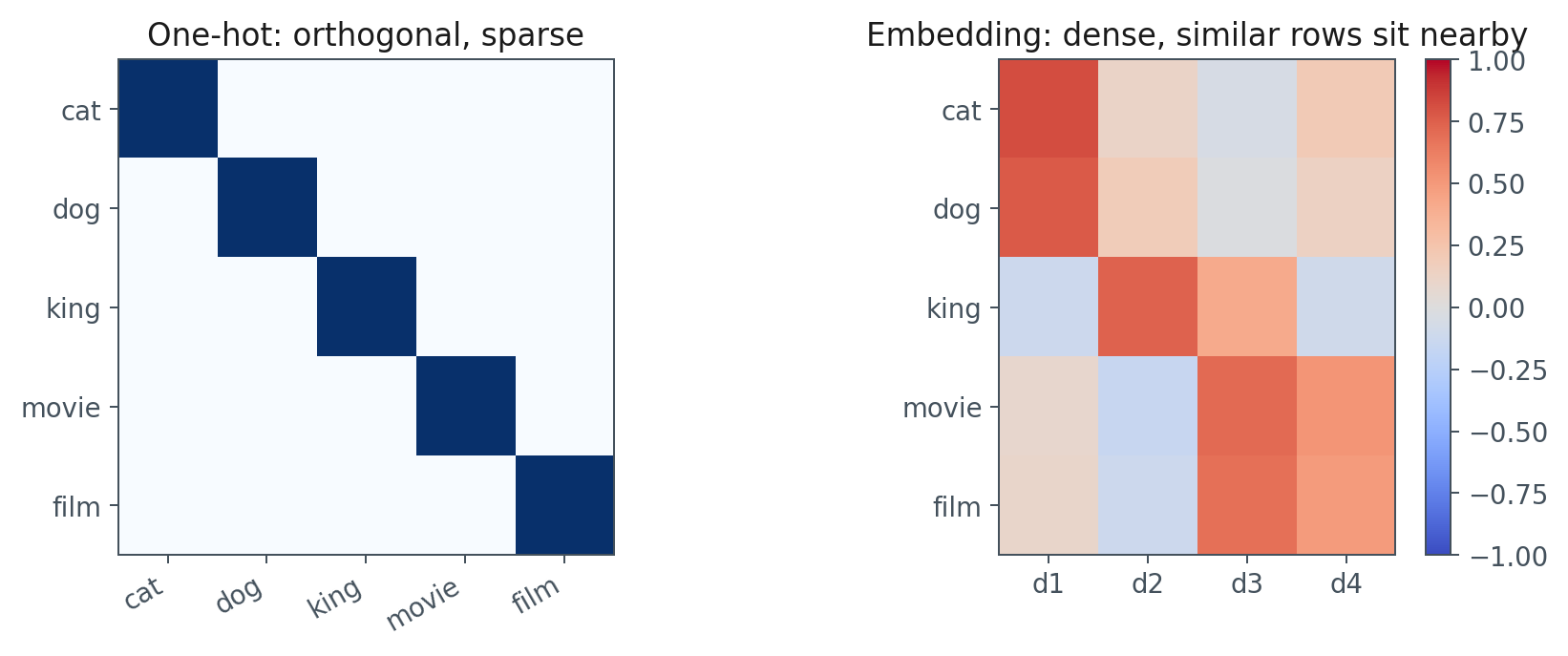
Distributional is about the data: words that occur in similar contexts mean similar things (Harris). Distributed is about the code: a dense vector. An embedding is the map from a token id into that vector. Write those three words on the board as a triangle. Mixing them is the most common exam slip this week.
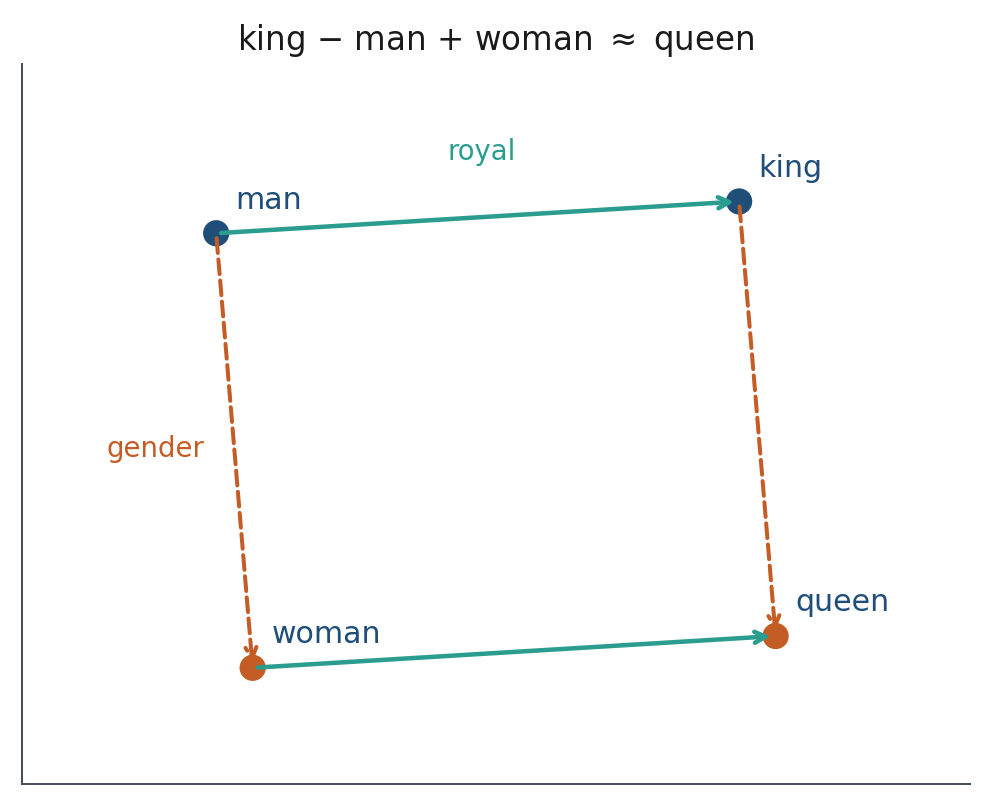
If the map is good, direction means something. The Mikolov analogy is the slogan:
The same offset can look like gender, tense, or capital-of. Week 3 will replace static rows with contextual states; the inner-product geometry does not go away.
2. Why we use it
One-hot geometry cannot say that film and movie are similar. You need a space where cosine is a useful neighbor query, analogies are a debug tool, and a downstream classifier can use a short vector instead of a -dimensional sparse indicator.
You do not type a definition. You count or predict company. Firth: you shall know a word by the company it keeps. Counting co-occurrences and then factoring the matrix is one distributional story. This course uses the predictive story (skip-gram) because it is the same training loop as an LLM.
Nearest neighbors are how you debug. If Paris sits next to France and Rome, training learned something. If it sits next to punctuation, the corpus or the window is wrong.
3. Architecture
The embedding is a table . Row is the vector for token . Input is a token id. nn.Embedding(V, d) is a lookup: row of that matrix. A one-hot times the matrix is the same map.
Word2Vec trains a small two-layer net on a fake task. Skip-gram: from the center word, predict each neighbor in a window. CBOW: from the neighbors, predict the center. After training, keep the center rows. Those rows are the embeddings. Throw away the softmax classifier ().
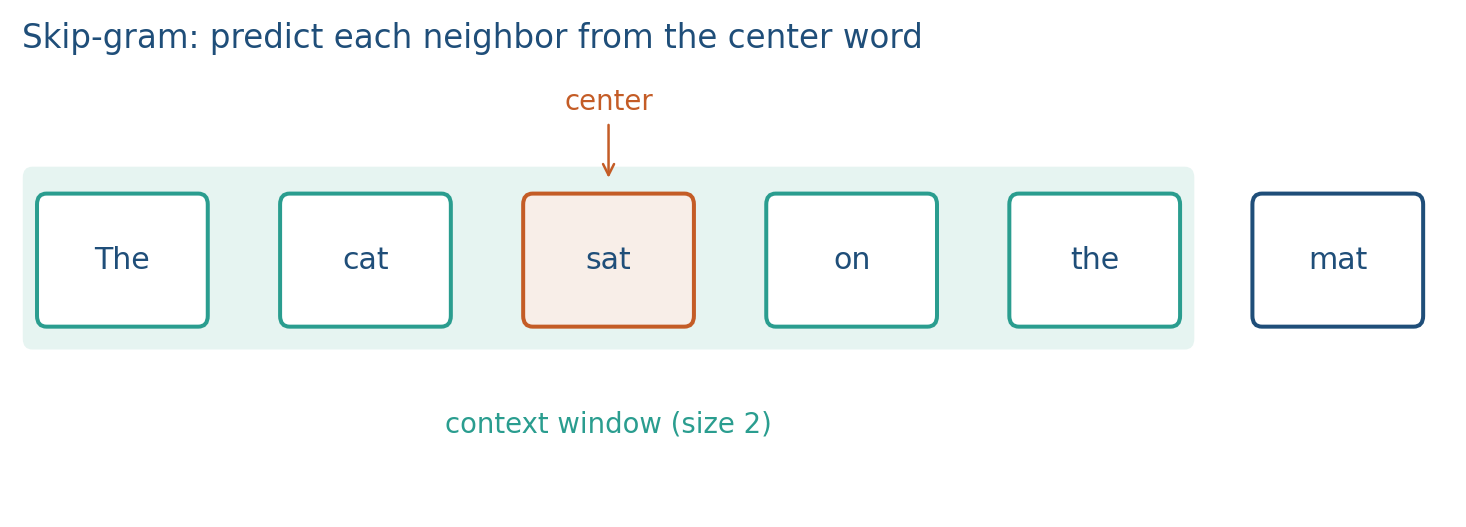
Let be the input (center) embedding of the center word, and the output embedding of a neighbor. You do not build a huge co-occurrence matrix and then factor it (that is LSA / GloVe; we do not assign SVD this week). A full softmax over 100,000 words is slow. Negative sampling (Mikolov 2013b) replaces it. We cite that paper; we do not derive it this week.
A transformer does not throw the rest of the net away: it keeps transforming those vectors. Word2Vec is the geometry without the rest of the stack.
4. How it works, step by step
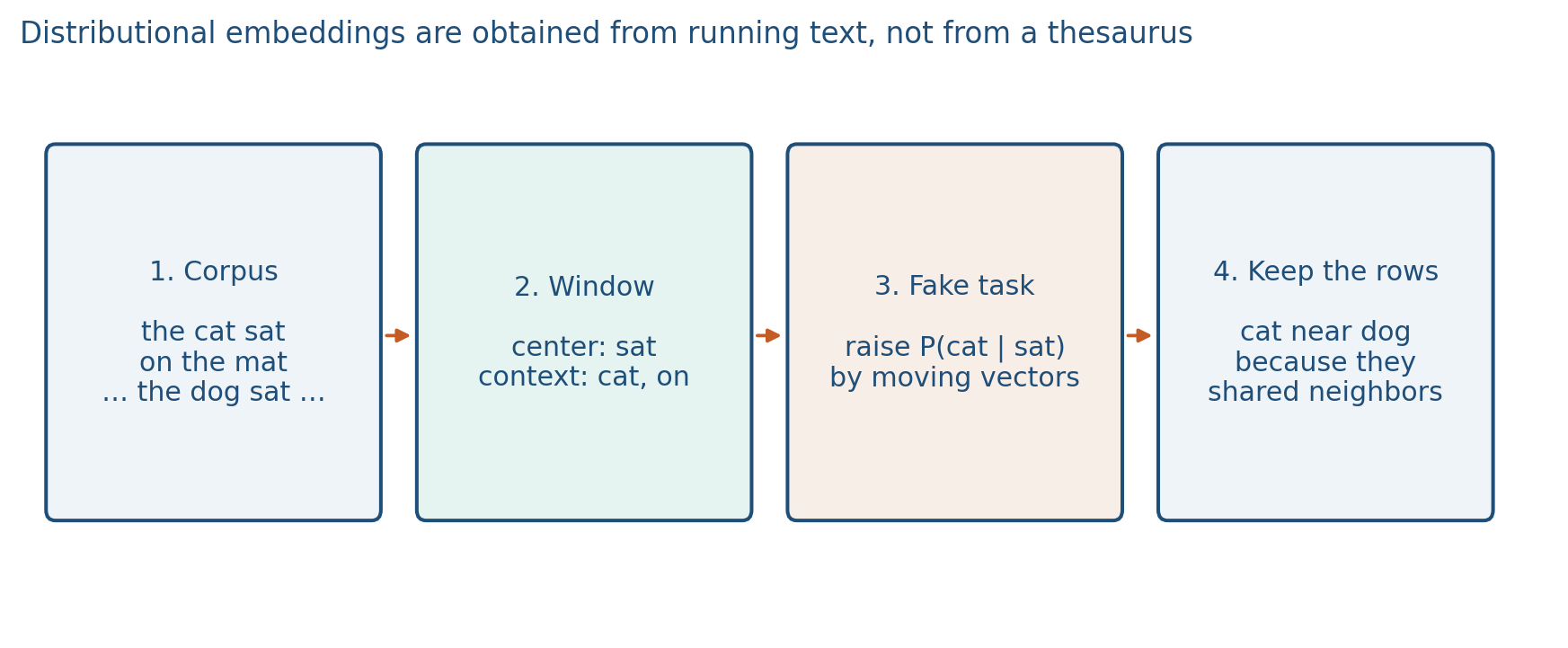
How a distributional embedding is obtained from a corpus:
- Take a corpus of running text.
- At each position, treat one word as the center and the nearby words as context (a window).
- Train a fake task: from the center, predict a neighbor (skip-gram), or the reverse (CBOW). Words that appear in similar windows get similar vectors.
- After training, keep the center rows. Throw away the softmax classifier.
That is why cat sits near dog: they kept similar neighbors, not because someone labeled them as animals.
You measure similarity with cosine, not Euclidean distance (length is partly frequency):
It ignores length. That is why a frequent word with a long vector can still sit next to a rare synonym.
The same offsets that encode “capital of” can encode stereotypes. Occupation words often sit along a she/he direction in older embeddings. That is not a bug in cosine; it is a property of the training text.
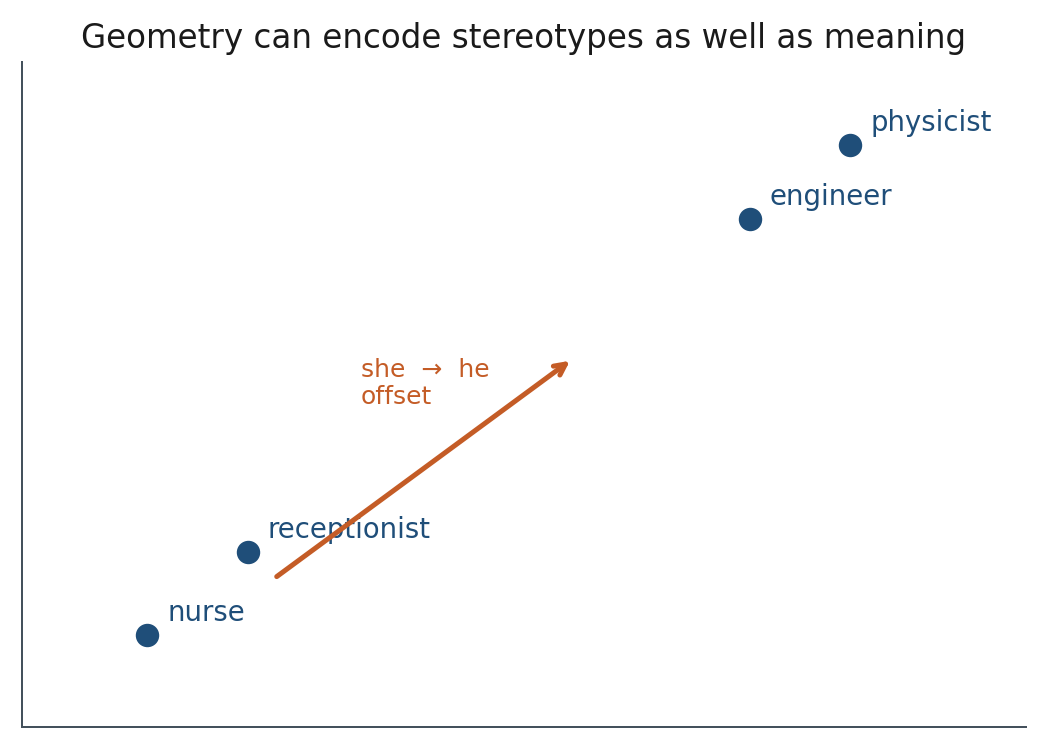
Lab 1’s probe is the signed projection onto :
A larger score sits closer to he in this constructed space. Debiasing is incomplete; reporting the probe is part of the project writeup when your system ranks people, jobs, or medical outcomes.
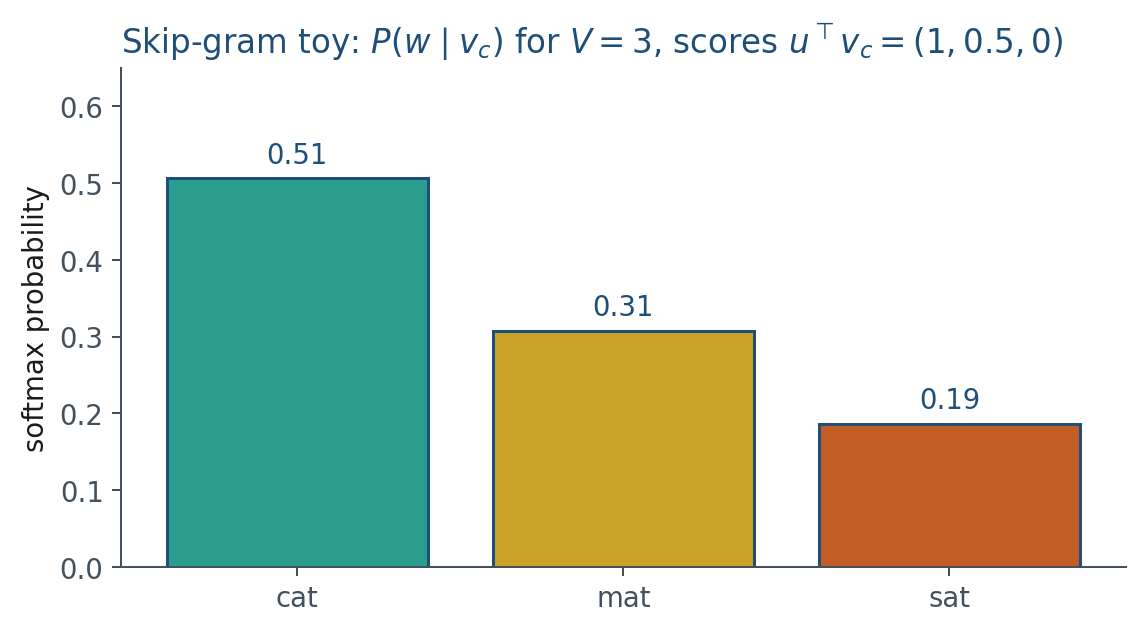
Tiny vocabulary . Take center the with , and output vectors , , . The three scores are , , . Softmax:
5. Mathematical formulas
Skip-gram’s softmax (Mikolov §§1–3) is the same softmax as note 1.2, with logits :
Cosine similarity:
Bias probe used in Lab 1, with :
The analogy arithmetic is vector addition in the same space: .
6. Positive points and negative points
Positive.
- Analogies and nearest neighbors are a cheap debug tool: if Paris sits next to France, training learned something.
- Cosine ignores length, so frequency-driven vector magnitude does not dominate a neighbor query.
- Skip-gram uses the same softmax-and-loss loop as an LLM, so this week is not a dead-end method.
- A lookup is the token embedding table inside a transformer as well.
Negative.
- Static vectors: one vector per word type, so bank (river) and bank (money) share a row. Week 3 replaces this with contextual states.
- Bias in the corpus becomes geometry. Occupation probes along are a property of the text, not a cosine bug.
- Euclidean distance makes frequent (long) vectors look far from rare synonyms.
- Analogy accuracy is an intrinsic score; it need not predict your project’s downstream metric.
- A full softmax over a large is slow (negative sampling exists; we do not derive it this week).
When not to. If you need a vector that depends on the sentence, a static table is the wrong object. That is why Week 3’s contextual states exist.
7. Intrinsic versus extrinsic evaluation
Intrinsic: does the space look right on its own? Analogies, word similarity datasets, clustering of synsets.
Extrinsic: plug the vectors into a downstream model (sentiment, retrieval, NER). If the task score moves, the embedding helped that task.
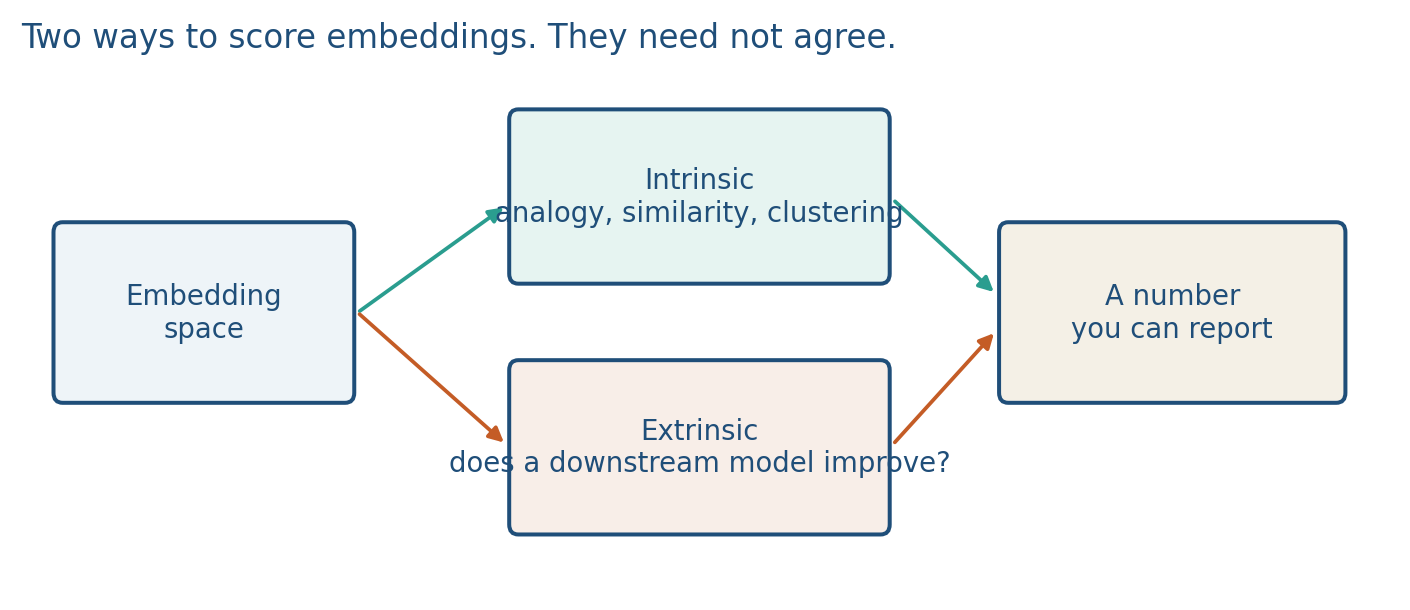
They need not agree. A space that wins analogies can still be a weak feature for your classifier. For a project, extrinsic is the number that matters. Intrinsic is how you debug.
8. Teaching this note
~18 minutes. One-hot vs dense, then the four-box pipeline (corpus → window → fake task → keep the rows), then skip-gram’s on the softmax, then cosine, then the occupation projection so Lab 1’s probe is not a surprise. StatQuest Word2Vec is homework (0:00–12:00, skip-gram vs. CBOW).
9. Worked example
Three 2-D vectors:
Cosine() . Cosine() . One-hot versions of the same three words would all be orthogonal.
Bias probe aligned with Lab 1: . If , , then and . For and ,
Engineer sits toward he; nurse sits toward she. The CSV in Lab 1 was built to make that split visible. On a real model you report the same probe, not this cartoon.
10. Where students get stuck
- Using Euclidean distance and then “the frequent word is never nearest.”
- Calling the one-hot vector an embedding because it is a vector.
- Treating analogy accuracy as the project metric.
- Thinking an embedding file appeared without a corpus: skip the four-box pipeline.
11. Video
Watch StatQuest: Word Embedding and Word2Vec, Clearly Explained.
Pause on skip-gram vs. CBOW, and on the moment the hidden weights become the embedding table. You can skip the neural-net-from-scratch recap if note 1.2 already landed.
12. Practice
-
In one sentence each: distributional, distributed, embedding.
-
Why is cosine the default similarity?
-
Give one intrinsic and one extrinsic test for a word embedding. Which one would you put in a project report?
-
Compute cosine between and . Then compute . Which number changed more when you replace by ?
-
In 2-D, , , . Compute . What point would you hope near?
-
With and scores for cat, mat, sat, which word does skip-gram call most likely? Write the three softmax probabilities to two decimals.
-
In four short lines: how is a distributional embedding obtained from a corpus? (Corpus, window, fake task, what you keep.)