
1.1 Course Map and the Semester Project
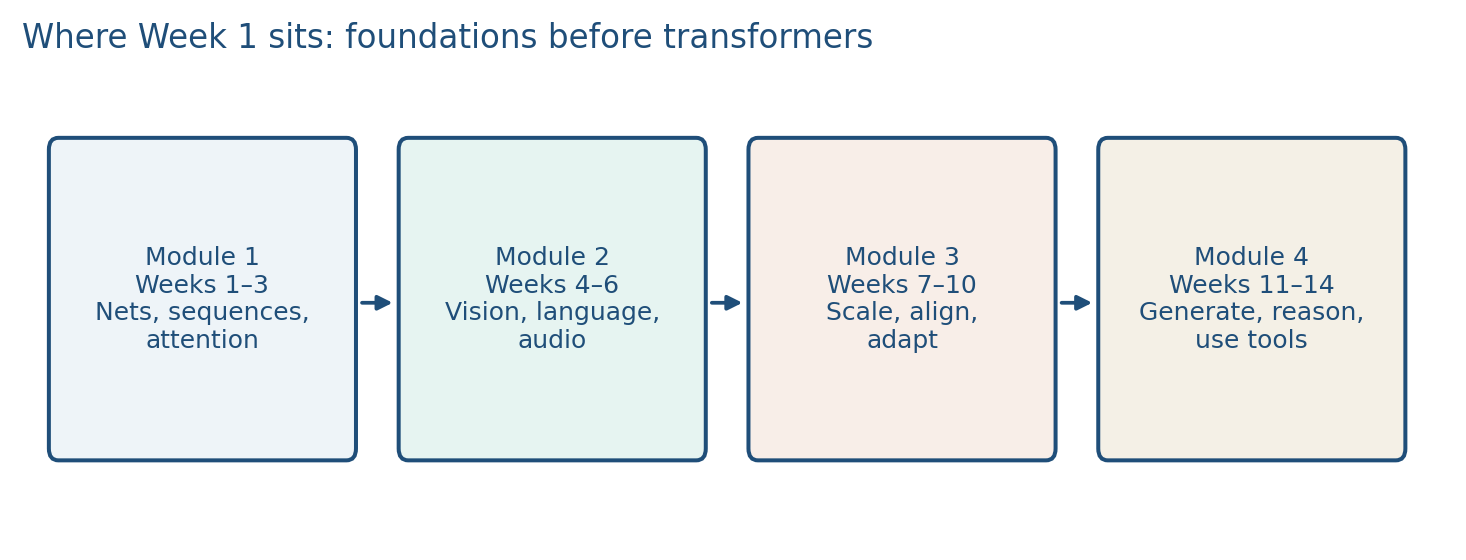
Four modules, one stack. Week 1 is the base; next-token NLL is the cost; the project names a layer you will change.
These notes match the lecture slides. Use (slides) on the course hub for the deck.
A yellow bar on the left is Python code. A gray bar is the output.
DATA 443/643, Advanced Concepts in Large Language Models, is a self-contained course on how language systems are built, trained, adapted, and checked. The listed prerequisite is DATA 427/627. DATA 441/641 and DATA 442/642 are not required: when this course uses a neural net or an embedding, it teaches it here. The semester job is a measured project. This note is the map for that job: four modules, one stack, the loss that trained the weights, and a project sentence that names one layer you will change.
1. What the course is
The semester is four modules, taught bottom-up:
- neural nets and embeddings, then sequence models, then transformers
- how those models are scaled and aligned
- multimodal systems (vision, language, and audio)
- generation, reasoning, retrieval, and tool use
That is one object, not four electives. Software: Python, PyTorch, Hugging Face, Jupyter. Canvas remains official for due dates.
2. A language model is a stack
The roadmap is the calendar. The stack is the same object as a deployed system.
Chat products sit at the top: decoding, tools, a UI. The weights you never see still came from next-token training at the bottom. Week 1 is that bottom: a neuron, a training loop, and a vector for a word. Week 3 puts attention on those vectors. Later weeks align, retrieve, and ship.
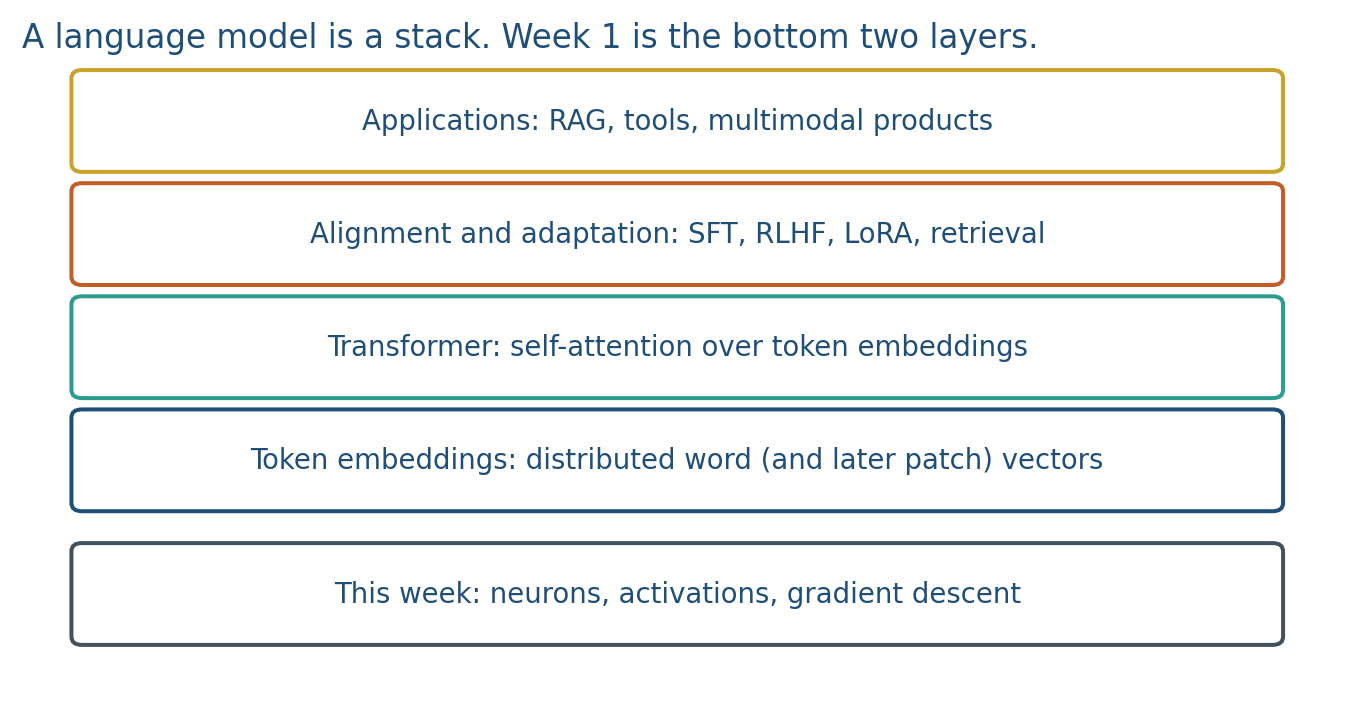
If you already know MLPs and Word2Vec, treat this week as a fast map into the rest of the course. If you do not, this week is the on-ramp. Either way, when a project “uses GPT,” name the layer you will actually change: data, a prompt, an adapter, a retriever, or an eval.
3. What those weights were trained to do
A language model is a distribution over tokens. For a sequence ,
Each factor is a softmax over the vocabulary (note 1.2 writes the definition). Pretraining minimizes the negative log-likelihood of the observed tokens, also called the next-token cross-entropy:
Tiny numeric: suppose the model assigns . The NLL of that one token is . If it had assigned , the NLL would be . That scalar is what gradient descent (note 1.3) walks downhill on, at web scale.
You will not train a transformer this week. You will train the same kind of scalar on XOR and on a three-word skip-gram softmax.
Those trained numbers have to live somewhere. Karpathy’s running example is Llama 2 70B. Each parameter is stored as 2 bytes (float16), so the weights file is
Write two columns: parameters file vs run file. Running the model needs extra memory for activations; 140 GB is only the file of numbers. In that picture an LLM is two files: the weights and a little code that reads them.
4. The project names one layer
Walk a chat product down the stack you just drew: next-token pretraining (Weeks 1–3), post-training (Weeks 8–9), retrieval and tools (Week 14). Circle the one layer a student project can actually change. Then write a sentence that is a question plus a metric, not a method.
Bad: “Use LoRA on news.” Better: “Does a LoRA adapter on local news reduce entity hallucination vs. the base model, measured by exact-match on a 100-item holdout?”
The full contract is the project overview. The shape you need this week:
- a question you can measure
- a public dataset or a well-scoped corpus
- a baseline, then one change the course material justifies
- an ablation and an honest failure case
- a proposal, a talk, and an IEEE-style report
Undergraduate teams; graduate students solo or a small team, as posted on Canvas. Graduate students also complete a mini-project on a recent paper (reproduce or extend one experiment). That is separate from the main project.
Do not wait until October. After Lab 1 you should be able to name a domain (news, clinical notes, code, speech, images+captions) even if the method is still “we will fine-tune something.”
5. What Week 1 is for
Notes 1.2–1.4 and Lab 1 are the base of the stack in the figure. By the end of this meeting you should be able to:
- write the forward pass of one neuron and of a small MLP, including sigmoid, ReLU, , and softmax
- take two gradient-descent steps by hand, and write one ReLU unit’s chain rule
- explain skip-gram’s softmax over a tiny vocabulary, and why Word2Vec keeps the lookup table
- tell intrinsic evaluation of embeddings from extrinsic evaluation
- name one way geometry can encode bias, with the signed-projection probe from Lab 1
This week does not include attention, LoRA, GloVe, or a history-of-NLP lecture. Those wait.
6. Teaching this note
~26 minutes, including a short Karpathy clip. Draw the four-module roadmap, then the stack, then the next-token product and the 140 GB file. Spend the remaining minutes turning “I want to use an LLM” into a measurable project sentence. Play 0:00–8:00 of Karpathy in class (two files, then next-token compression). Stop before the post-training tour.
The rest of the two-hour meeting: 1.2 neuron / XOR (~16 min) → 1.3 gradient descent (~18 min) → 1.4 skip-gram and bias (~18 min) → Lab 1 start (~32 min). Remaining videos are homework, not in-class playback.
7. Worked example
Put Llama 2 70B and a chat box on the same board.
- Parameters file: bytes GB. The run file is larger.
- Walk the chat box down the stack. Circle one layer a project can change.
- Rewrite the topic. “Use LoRA on news” becomes the better sentence in section 4.
8. Where students get stuck
- Treating the course as “how to prompt ChatGPT” instead of a stack you can measure.
- Picking a method first (“we will fine-tune”) before a question and a dataset.
- Assuming DATA 641/642 is required, then tuning out of Week 1.
- Confusing the 140 GB weights file with the extra memory needed to run the model.
9. Video
In class: Karpathy: Intro to Large Language Models, 0:00–8:00 (two files, then next-token compression).
Homework: finish 0:00–20:00. Pause at 0:20 (an LLM is two files: weights + a little code), 4:17 (pretraining as next-token compression of the internet), 8:58 (“dreams” / fluent but ungrounded text), and 14:14 (fine-tuning into an assistant). Stop at the 17:52 summary. The rest of the hour is optional.
Also after class, not in the meeting: Intro to deep learning: perceptron through gradient descent from the perceptron (~17:20) through loss and gradient descent (~44:22). That is the homework-video twin of notes 1.2–1.3.
10. Sources
Karpathy’s intro talk is this note’s video. For the rest of Week 1, read rather than skim-cite:
- Goodfellow, Bengio, Courville, Deep Learning, Chapter 6 opening and §6.1 XOR: deeplearningbook.org/contents/mlp.html
- Nielsen, Neural Networks and Deep Learning, Chapter 1 on gradient descent (stop before the long MNIST writeup): neuralnetworksanddeeplearning.com/chap1.html
- Jurafsky & Martin, Speech and Language Processing (draft of 19 August 2026), Chapter 5 Embeddings: web.stanford.edu/~jurafsky/slp3/5.pdf. The live draft moved vector semantics here; do not follow an older “Chapter 6 = embeddings” label.
- Mikolov et al. (2013a), Efficient estimation of word representations, §§1–3: arXiv:1301.3781
Cite, do not assign: Rumelhart, Hinton, Williams (1986) on backpropagation; Mikolov et al. (2013b) on negative sampling.
Related university courses appear once on the title slide and under Extra materials on the hub. They are not homework.
11. Practice
-
Name one product you use that sits on the top of the stack in the figure. Which lower layer would you have to change to make it safer?
-
A classmate took DATA 641. Another did not. Why is Week 1 still required for both?
-
Write one sentence that could be a project question (not a method). Example: “Can retrieval cut hallucination on AU policy PDFs?” is a question. “Use LoRA” is not.
-
Llama 2 70B stores each parameter as 2 bytes. Compute the weights-file size in GB. If you instead stored the same 70 billion parameters as 1-byte integers, what would the file size be?
-
A model assigns and . What is the NLL of the two-token continuation “cat sat”? (Natural log is fine; leave it as .)