
4.3 Contrastive Learning and Zero-Shot Transfer
InfoNCE wants the diagonal. Zero-shot is nearest prompt, not a trained C-way head.
These notes match the lecture slides. Use (slides) on the course hub for the deck.
Contrastive learning pulls matched pairs together and pushes unmatched pairs apart, in a shared space. Zero-shot transfer is what you get when one side of the pair can be a class name written as text. This is a coordination loss: two towers, a similarity, no fused decoder. Week 5 will put CLIP’s data and retrieval on the table. This note is the loss and the zero-shot trick.
1. What contrastive learning and zero-shot classification are
Contrastive learning pulls matched pairs together and pushes the rest apart. Take images and captions. Encode both. Cosine similarities form an matrix. The loss (InfoNCE; Oord et al. 2018) wants the diagonal hot: image with caption , not caption .
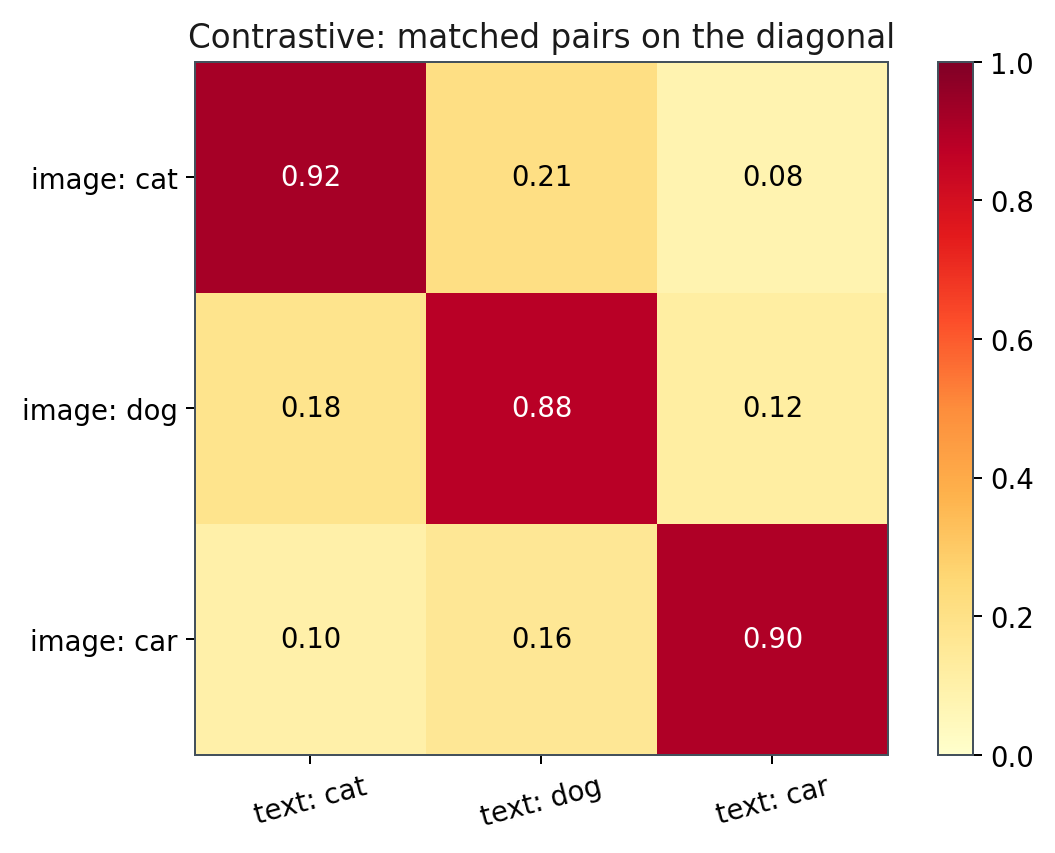
This is coordinated representation (note 4.1) with a specific loss. You never fuse pixels and words into one vector during pretraining; you only score pairs. SimCLR is the vision-only cousin (two crops of the same image). We cite it; we do not assign it.
Zero-shot classification is: classify by nearest prompt, not a -way trained head. At test time, encode the image once. Encode prompts "a photo of a dog", "a photo of a cat", and so on. Take the nearest prompt. There is no trained softmax over ImageNet. New classes are new strings.
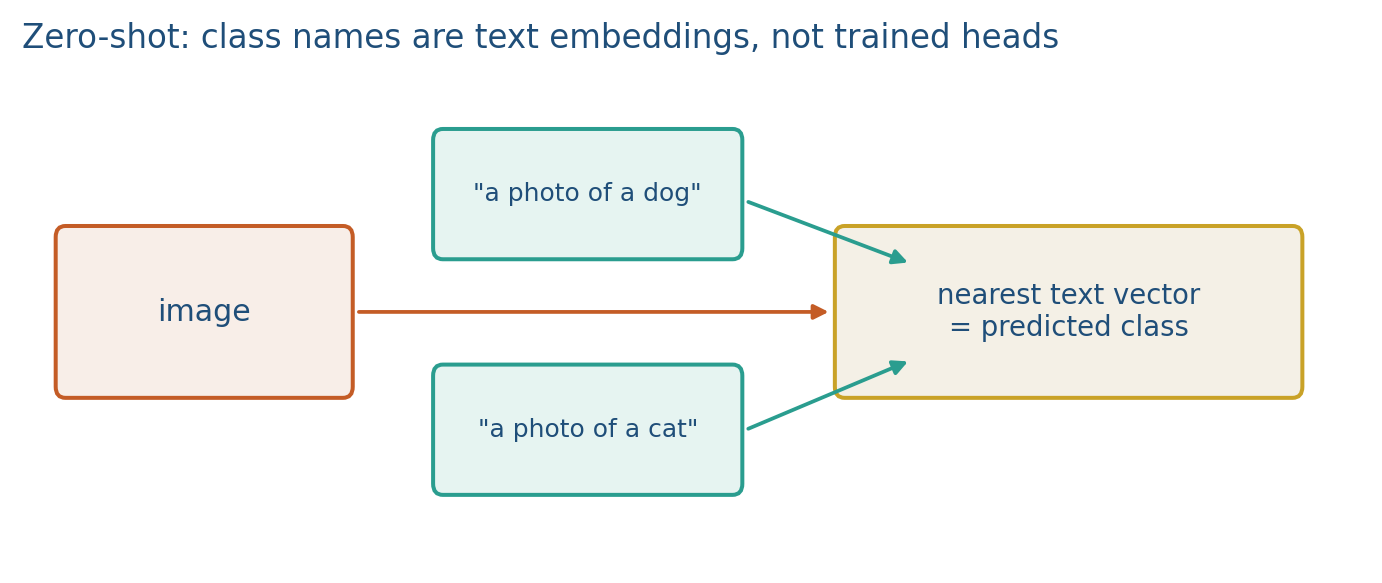
CLIP was trained on phrases. The raw label "dog" often loses to "a photo of a dog". Prompt ensembling (average several phrasings) is a test-time trick, not a new model. We mention it; Lab 4 does not require it.
A class the text tower never saw as a phrase will not magically appear. Open-vocabulary is not infinite-vocabulary.
2. Why we use it
You may not have labels for every class at train time. A similarity space transfers to new names: adding a class is adding a string, not training a new column of a softmax. That is why CLIP-style models are called foundation models for vision–language, and why this course treats contrastive learning as a method rather than a trick.
A -way head is the older default. It works when you have a labeled set for those classes. It fails when the next user wants a class you did not train. Zero-shot is the transfer story that does not need that labeled set.
Web pairs are noisy (Week 5: BLIP filters them). Contrastive spaces can still be biased (Week 5.3). The loss does not make the space fair; it only makes matched pairs closer than unmatched ones.
3. Architecture
Two encoders (or two views of one network). A batch matrix of scores. Softmax over the row (or both directions).
Image maps to . Text maps to . The interaction is cosine, not a concatenating MLP. CLIP uses both directions (image-to-text and text-to-image). Temperature sharpens the softmax. Small makes the diagonal even more peaked, but the argmax of a row does not change if you only rescale that row.
The negative set is the rest of the batch. Small batches easy negatives a weak space. CLIP’s real batch was tens of thousands. Lab 4 is so you can see the matrix, not so you can match ImageNet.
At test time the architecture does not grow a classification head. The classifier is the text tower, queried with class phrases.
4. How it works, step by step
Lab 4: four pairs, heatmap of the scores. The diagonal should win.
- Encode a batch. matched pairs. Image tower and text tower.
- Fill the matrix. . The diagonal is the true matches; the off-diagonal entries are negatives, not “don’t care.”
- InfoNCE on each row. Softmax over captions for a fixed image; the loss is of the diagonal probability. CLIP also does the other direction.
- Zero-shot at test. Freeze both towers. Embed the image. Embed one prompt per class. Predict .
- Do not add a class the text tower cannot spell. Open-vocabulary is not infinite-vocabulary.
If every caption is the same vector, every row of is constant, softmax is uniform, and the diagonal is not special: the loss cannot learn matching.
5. Mathematical formulas
Let . InfoNCE, one direction, averaged over the batch:
Row alone is
Zero-shot: embed class phrases, pick
Dividing the cosines by before a softmax changes the distribution, not the argmax of a single row of scores.
6. Positive points and negative points
Positive.
- No -way head at train time; new classes can be new prompts.
- The same space supports retrieval (rank by cosine) and zero-shot classification.
- Lab 4’s grid is the whole method in miniature.
Negative.
- Needs big batches so the negatives are hard enough.
- Temperature is a knob: it sharpens, it does not change argmax on one row.
- Compositionality is not free; a batch of 4 will not teach “mug in grass” versus “grass in a mug.”
- A class the text tower never saw as a phrase will not appear at test time.
When not to. If you already have a labeled set for a fixed and you only need those classes, a linear probe on a frozen encoder can be the tighter transfer. Zero-shot is for names you did not train as a head.
7. Linear probe versus zero-shot
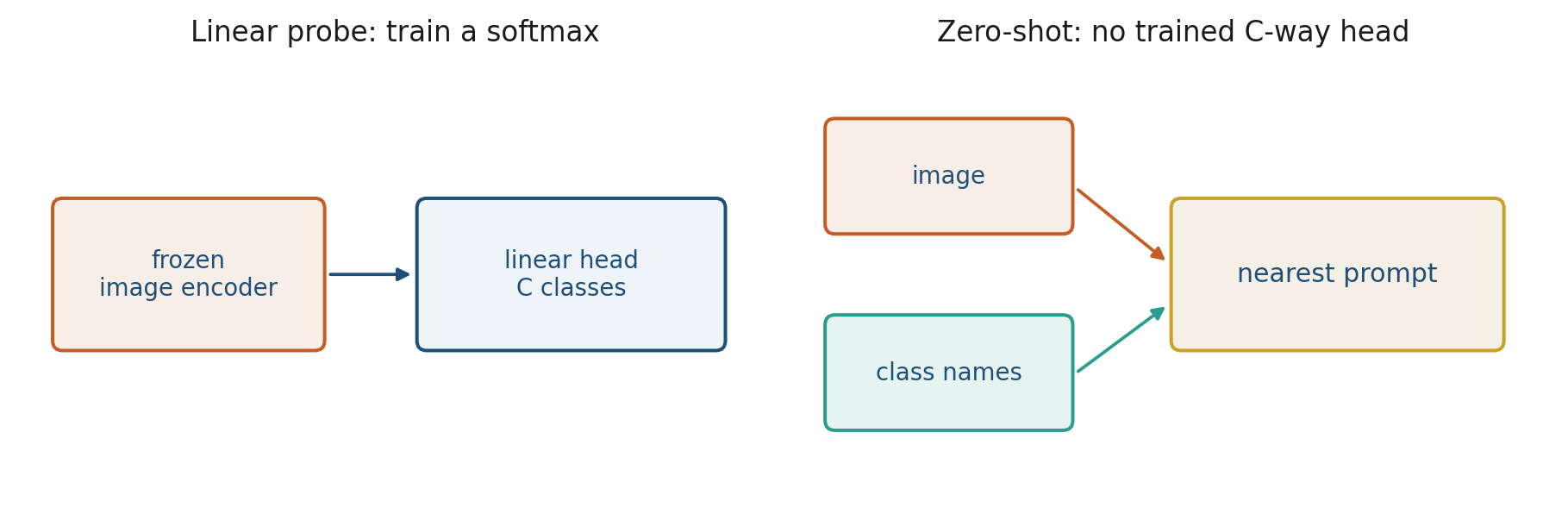
Linear probe: freeze the image encoder, train a -way softmax on labeled images. Needs a training set for those classes.
Zero-shot: no extra weights. The classifier is the text tower. Adding a class is adding a string.
Both are transfer. Zero-shot is what makes CLIP a foundation model. Captioning, LLaVA, and Flamingo wait for later weeks.
8. Teaching this note
~18 minutes. Draw the grid, mark the diagonal, write InfoNCE for , then swap the text side for class prompts, then probe vs zero-shot. Play the CLIP video on zero-shot and the similarity matrix (9:00–22:25). Lab 4’s tiny InfoNCE is this grid with .
9. Worked example
Two pairs. Cosine matrix (already normalized):
Row 0 softmax: , , so . InfoNCE term .
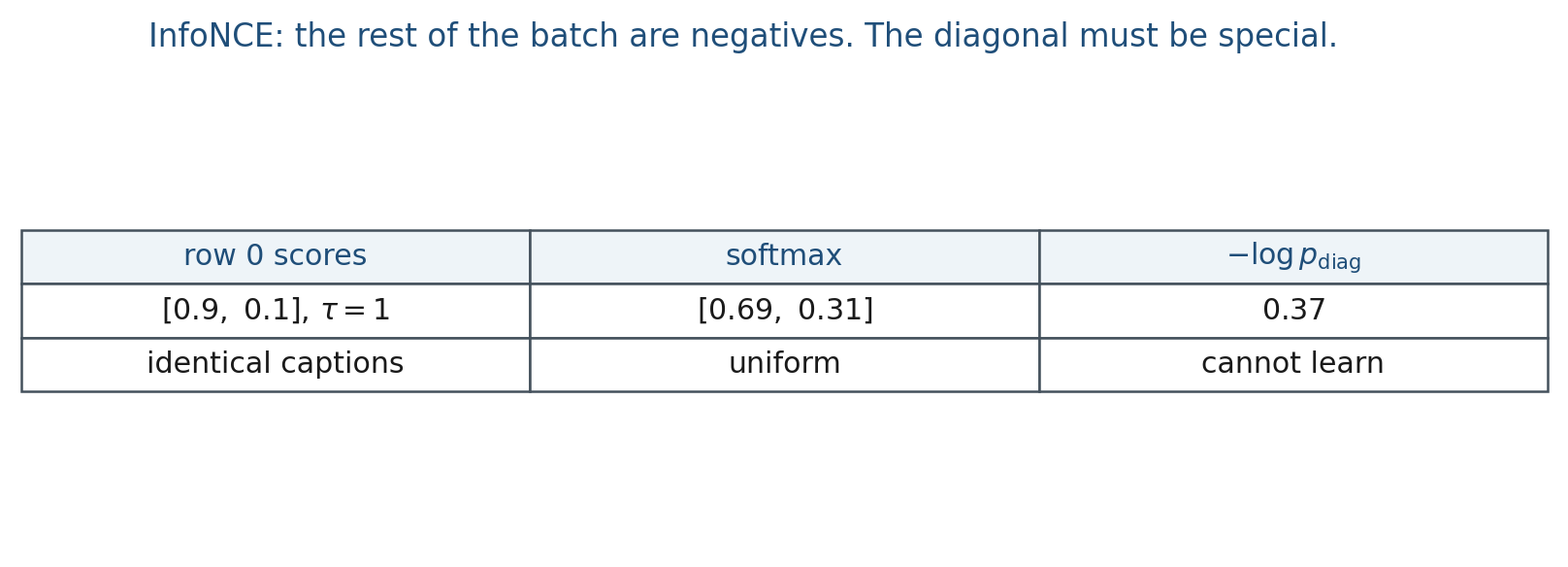
If every caption is the same vector, every row of is constant, softmax is uniform, and the diagonal is not special: the loss cannot learn matching.
Zero-shot: image , prompts , . Cosines vs . Predict dog. Dividing by before softmax does not change that argmax.
10. Where students get stuck
- Treating off-diagonal as “don’t care” instead of negatives.
- Adding a class at test time that the text tower cannot spell.
- Using batch size 4 in a real CLIP run and expecting ImageNet-level negatives.
- Calling zero-shot a trained ImageNet head.
11. Video
Watch Yannic Kilcher: OpenAI CLIP, Connecting Text and Images.
Pause on zero-shot (9:00) — class names as text — and on InfoNCE / the matrix (14:40). That matrix is the whole note.
12. Practice
-
If every caption in the batch is the word photo, what happens to the diagonal?
-
Why is
"a photo of a golden retriever"often better than"golden retriever"for CLIP-style zero-shot? -
Name one class you cannot add at test time by typing it.
-
For , , write the two InfoNCE row-losses (they should be ). Now change to . Recompute row 0’s softmax and .
-
Three prompts with cosines to one image . Which class wins zero-shot? If you divide the cosines by before softmax, does the argmax change?
-
Linear probe versus zero-shot: which one needs a labeled training set for the classes?
-
CLIP uses both image-to-text and text-to-image InfoNCE. Why is one direction not enough if you also want to retrieve images from a caption?