
5.1 CLIP
Two towers and a cosine. CLIP scores pairs; it does not decode a sentence.
These notes match the lecture slides. Use (slides) on the course hub for the deck.
CLIP (Radford et al., 2021) is the coordinated, contrastive model that made zero-shot vision–language the default. After training you have a similarity score between an image and a text, not a captioner. Note 4.3 already taught InfoNCE and the zero-shot trick. This note is the two-tower product: what you keep, what you call at test time, and why batch size and temperature are part of the method.
1. What CLIP is
CLIP is two towers and a cosine. An image encoder (ResNet or ViT) and a text encoder (a transformer) both emit a vector in the same dimension. Training is InfoNCE on the batch (note 4.3). After training you keep both towers; you do not keep a fused head. The model scores image–text pairs. It does not write a caption.
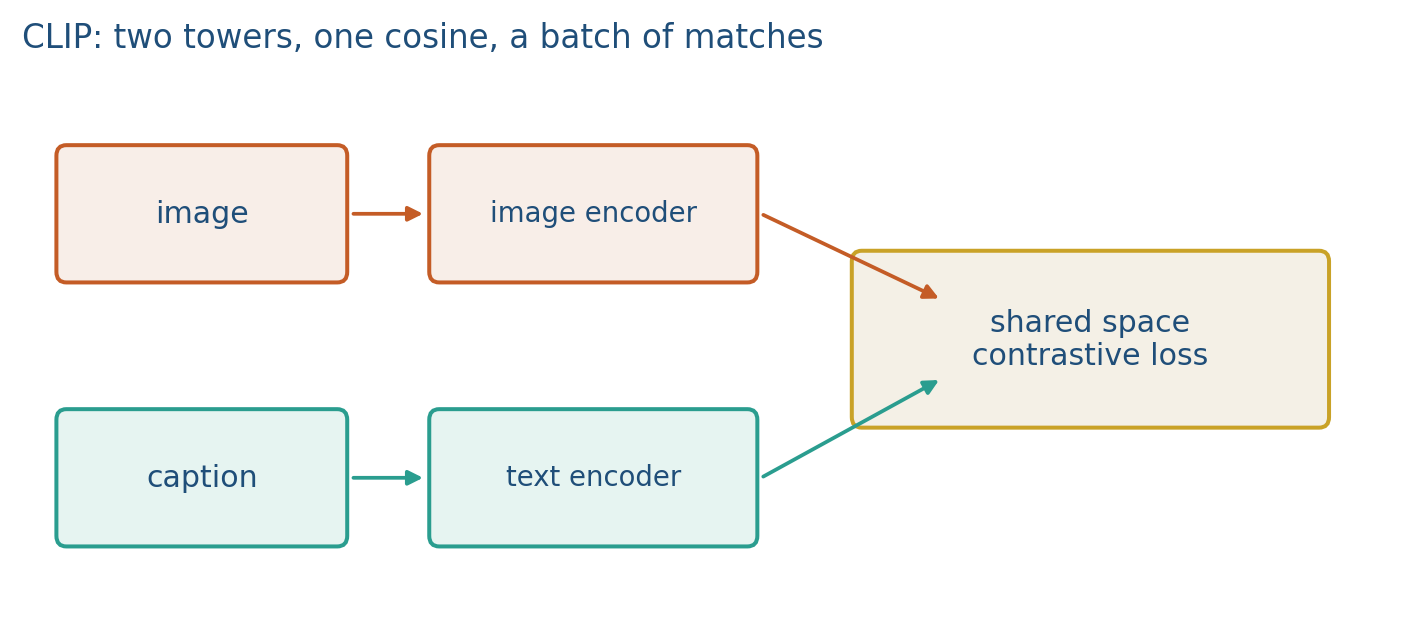
The text tower never sees pixels. Retrieval still works because training put matched pairs at high cosine. A query string is just another text vector.
Open-source copies (OpenCLIP, SigLIP) change the loss or the data. The picture is stable. SigLIP replaces the softmax InfoNCE with a sigmoid on each pair; you still have two towers and a score.
Write the API on the board: encode_image, encode_text, cosine. Three calls. No generate.
2. Why we use it
One model that retrieves and zero-shot classifies without a detector or a decoder. That is the product reason CLIP became the default vision–language backbone.
- Zero-shot classification via prompts (
a photo of a dog). - Cross-modal retrieval: image text and text image (note 5.3).
- A frozen image backbone for later captioners and diffusion models (Week 12).
What it is not: a captioner (it does not decode a sentence), a detector with boxes, or a guarantee of factual correctness. It scores pairs.
CoCa is next after CLIP: add a decoder with a captioning loss. That generation job is note 5.2 (BLIP). Do not skip from CLIP to LLaVA in this hour.
Prompt wording is part of the method. A single phrase can be too peaked; ensembling "a photo of", "a drawing of", and similar templates is optional engineering, not a new model.
3. Architecture
Two separate encoders, a shared embedding dimension, and a cosine. No concatenated pixels-and-tokens vector during pretraining.
The image tower can be a ResNet or a ViT (note 4.2). The text tower is a transformer that encodes a whole caption into one vector. Both outputs are -normalized before the cosine, so the score is a dot product of unit vectors.
You never call generate. Hugging Face CLIPModel plus a processor is enough for Lab 5’s idea; the lab itself uses a toy space so nobody waits on a download. If a project cites “CLIP,” name the Hugging Face id. Freezing is allowed. Pretending freeze is fine-tune is not.
SigLIP keeps the same two-tower picture and changes the pairwise loss. Do not treat a new checkpoint name as a new architecture unless the paper adds a decoder.
4. How it works, step by step
Train on web image–text pairs. At test, embed the image and a list of prompts. Note 5.2 adds a decoder (BLIP).
- Index a batch. images, captions, already matched as web pairs.
- Encode.
encode_imageandencode_text. -normalize. - Score. Fill the cosine matrix. InfoNCE wants the diagonal, both directions, with temperature (often learned, around ).
- Keep both towers. Throw away the training matrix. You now have two encoders you can call independently.
- Zero-shot or retrieve. Embed the image once; embed prompts or gallery texts; rank by cosine.
Temperature sharpens the batch softmax. Small makes off-diagonal competition brutal; that is why CLIP wanted huge batches.
CLIP-style models rely on batch size to learn fine-grained concepts. A batch of 8 has 7 negatives. A batch of 32{,}768 has 32{,}767. You still will not see both “a mug in grass” and “grass in a mug” in one batch; compositionality is a later paper, not this lecture.
A batch of 2 still has only one negative. CLIP cannot emit “a cat sits on a mat” unless that string is already in your gallery. That generation job is BLIP.
5. Mathematical formulas
Same InfoNCE as note 4.3, with a learned temperature. For -normalized vectors, cosine is a dot product. The image-to-text term on row uses logits :
CLIP averages this with the text-to-image direction. The public API is three calls: , , then .
Small does not change the argmax of a row of ; it changes how peaked the softmax is during training.
6. Positive points and negative points
Positive.
- Zero-shot classification and both directions of retrieval from one pair of towers.
- A frozen image backbone you can reuse in captioners and diffusion models.
- Open copies (OpenCLIP, SigLIP) keep the same picture if you name the checkpoint.
Negative.
- Not a captioner: there is no
generate. - Hungry for batch size; a batch of 8 is a weak negative set.
- Prompt wording is part of the method, not a footnote.
- Bias and typographic attacks wait for note 5.3; a high cosine is not a fairness certificate.
- Fine-tuning a fused head and throwing away the text tower means you can no longer query with words.
When not to. You need generated captions, not retrieval. Use BLIP (or CoCa’s decoder), not CLIP.
7. Teaching this note
30–40 minutes. Two towers, cosine, “not a captioner,” then the and batch-size arithmetic. Play the CLIP paper video in class as selected chapters: towers 4:40–9:00, contrastive 14:40–22:25. Students can finish the hour as homework. Lab 5 is a 2-D fake CLIP, not OpenAI weights.
Minute plan: 10 min two towers; 10 min worked and ; 5 min “cannot decode a sentence”; 12 min video chapters. Assign robustness to note 5.3.
8. Worked example
Batch . Already -normalized:
Cosines (the matrix ):
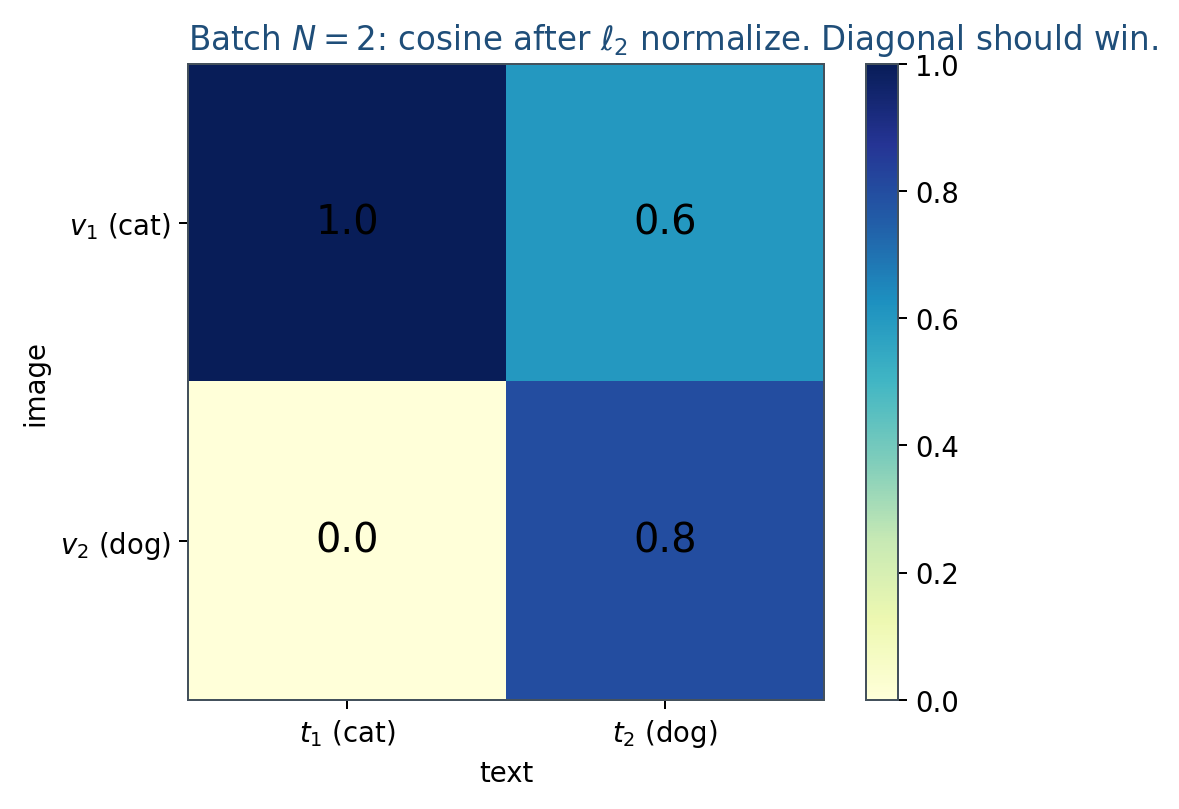
InfoNCE on row 1 uses logits . With ,
With , the logits are . The match probability is about . Same scores; the temperature did the work.
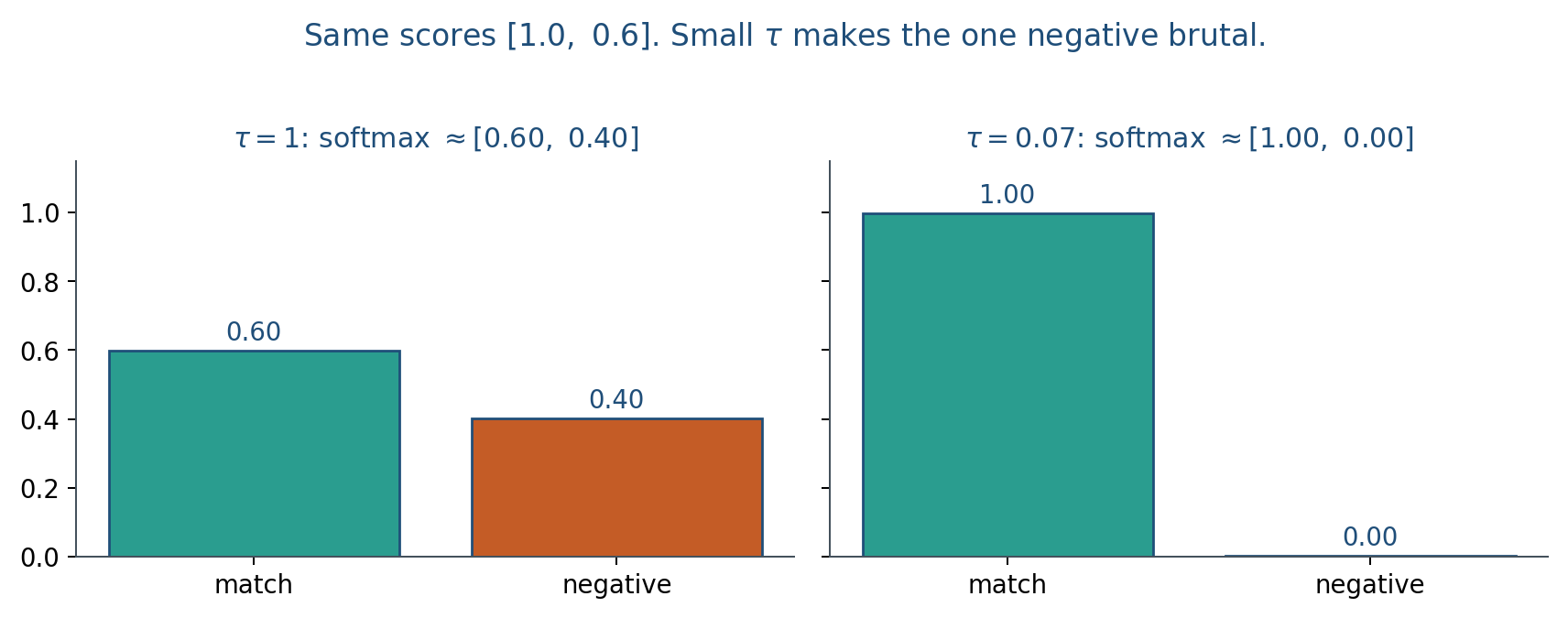
A batch of 2 still has only one negative. CLIP cannot emit “a cat sits on a mat” unless that string is already in your gallery. That generation job is BLIP.
9. Where students get stuck
- Asking CLIP to write a caption.
- Fine-tuning a fused head and throwing away the text tower (you can no longer query with words).
- Ignoring and wondering why a 2-D toy with looks “softer” than the paper.
- Using and calling it unit length. Check before you trust the cosine.
10. Video
Watch Yannic Kilcher: OpenAI CLIP, Connecting Text and Images (full paper video).
In class, pause on two towers, the InfoNCE matrix, zero-shot prompts, and the remark that prompt wording is engineering. Watch the rest after class.
11. Practice
-
CLIP’s text tower never sees the pixels. How can a typed query retrieve a photo?
-
Why does a batch of 8 give weaker negatives than a batch of 1024?
-
You need generated captions, not retrieval. Which Week 5 model is the closer ancestor?
-
For logits (already divided by ), compute the softmax probability on the positive. Repeat for . Which temperature makes the positive dominate?
-
Two gallery texts , , query image (already unit). Rank the texts by cosine. Who is retrieved at rank 1?