
13.1 Chain-of-Thought
CoT is extra tokens, not a new net. 17×24 → 408 on the tape.
These notes match the lecture slides. Use (slides) on the course hub for the deck.
Chain-of-thought (CoT) is the habit of writing steps before the answer. You are not changing the weights. You are changing what the decoder is asked to emit. By the end you should be able to write a direct prompt and a CoT prompt for the same item, say when extra steps help, and name one number besides final-answer accuracy.
1. What chain-of-thought is
Chain-of-thought (CoT) is writing steps before the answer. A direct prompt is “What is 17 × 24?” A CoT prompt is “Show your work, then give the number.” Few-shot CoT puts worked examples in the context. Zero-shot CoT is often the sentence Let’s think step by step.
This is a prompt / decoding choice, not a new architecture and not a fine-tune (unless you later trained on traces). The model still predicts tokens. Extra tokens are extra test-time compute. The weights do not change.
Intermediate tokens can allocate compute: they store partial products, units, or a plan. That helps multi-step arithmetic, symbolic puzzles, and some school-science items. It does not magically add retrieval (Week 14) or tools. A longer string is not “thinking” in the everyday sense; it is extra decoding you can inspect.
Karpathy’s phrase is System 2 as more tokens. Same idea: each token is a fixed-size compute step, so a hard problem needs a longer tape.
Zero-shot vs few-shot is a method choice. Few-shot CoT is only as good as the traces you paste: same task, same answer format, same units. A mismatch is not “the model cannot reason”; it is a context that points at the wrong procedure.
2. Why we use it
Multi-hop arithmetic can use the tape. A four-hop word problem has intermediate quantities that need a place to sit. Direct decode might jump to a familiar number (400, 408, 428) with no check. CoT gives the model room to write , then , then add.
It can hurt on tasks that are a single lookup: extra steps are extra chances to wander. “Capital of France?” does not need hops. A CoT prompt can invent a story (“Lyon was the capital in…”) and then still say Paris—or wander to Lyon.
Longer traces cost latency and dollars. For a project, CoT is a method knob, not a personality. You still need a metric on the answer, and a separate look at the trace (note 13.3). A correct box after a wrong derivation is not the same system as a correct derivation. Self-consistency (note 13.2) is what you do when one chain is too noisy to trust.
3. Architecture
The architecture is the same language model. What changes is the prompt and the length of the generation. You parse a final boxed answer separately from the trace (note 13.3). There is no new layer, no extra head, and no tool in this note.
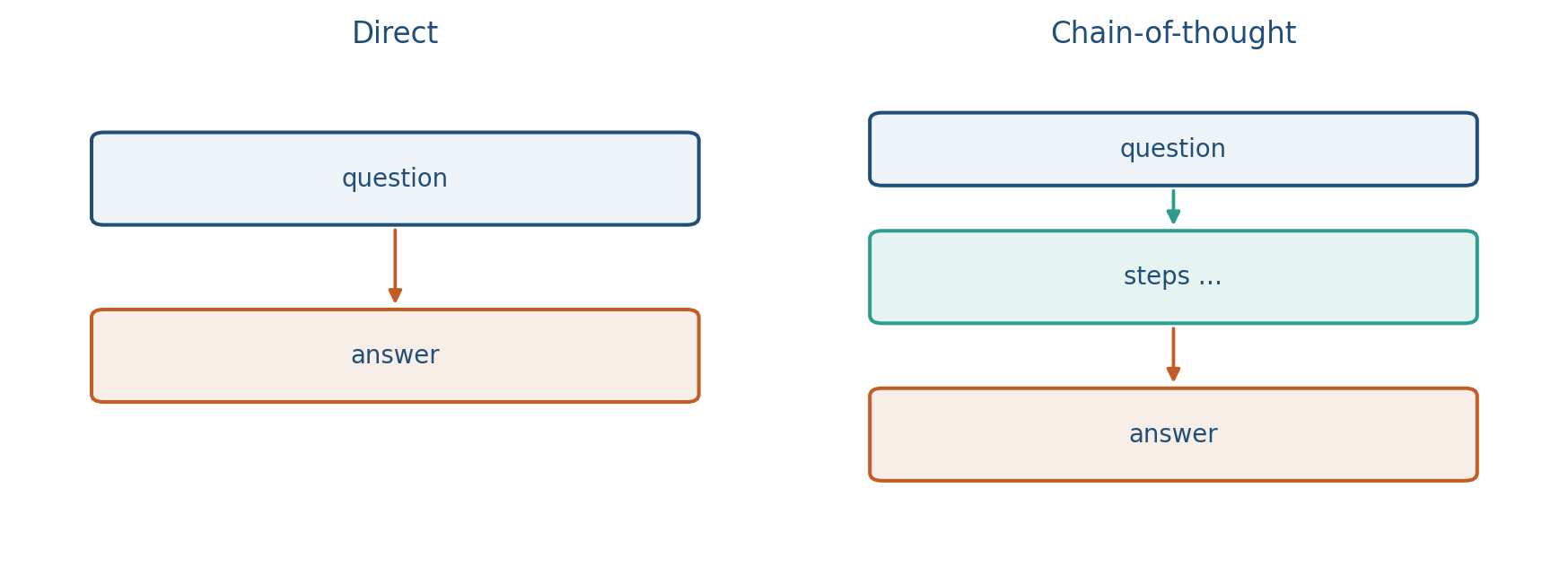
Freeze the instruction and the decoding settings (temperature, max tokens) when you report a number. Temperature 0 is one greedy chain, not a vote (note 13.2). If you raise temperature to get diverse traces, you must still parse a final answer the same way every time.
Lab 13 grades traces as strings, with no API. The lab’s 23+19 items are the same algebra as the cartoon with smaller numbers.
4. How it works, step by step
Take .
- Direct prompt. “What is ?” Decode a short answer. The model may jump to a familiar number with no check.
- CoT prompt. “Show your work, then the number,” or paste few-shot traces, or write Let’s think step by step.
- Generate a longer string. The model still samples . The prompt asked for steps, so the string contains them.
- Parse a final boxed answer separately from the trace. Gold for this item is 408. Lab 13’s
23+19traces are the same idea. - Score two things. Answer accuracy on the box, and a trace check (note 13.3). Do not claim the model “reasoned” unless you have a check on the steps.
A CoT string that actually computes writes , , . Three intermediate lines hold partial products. That trace is also faithful (note 13.3): the last computed value matches the box. A CoT-shaped line that computes and then boxes 408 is the unfaithful cousin.
5. Mathematical formulas
The model is still next-token prediction. Let be the CoT prompt (instruction, optional few-shot traces, and the question). The joint string of steps and answer is
There are no new parameters. CoT changed and the length of , not .
Temperature 0 is at each step: one greedy chain. That is a baseline, not self-consistency.
6. Positive points and negative points
Positive.
- Extra tokens are extra test-time compute, which can hold partial products on multi-hop items.
- You can inspect the tape; Lab 13 grades traces as strings without an API.
- Zero-shot and few-shot are cheap knobs compared with training a new net.
- A correct, faithful trace (last computed value matches the box) is something you can show.
Negative.
- Extra steps can hurt one-hop lookup: more tokens are more chances to wander.
- Latency and cost scale with trace length.
- Fluent wrong algebra still looks like work; faithfulness is the next note.
- CoT is not retrieval and not tools. A longer string does not fetch a PDF or run a calculator.
- Few-shot traces from the wrong task point at the wrong procedure.
When not to. A single-hop fact lookup. A task that needs a document (Week 14 RAG) or an exact product (a calc tool), not more prose.
7. How to write it in a report
Say whether the prompt was zero-shot or few-shot, paste the exact instruction, and freeze decoding settings (temperature, max tokens). Do not claim the model “reasoned” unless you have a check on the steps. Temperature 0 is a single greedy chain: useful as a baseline, not as a vote (note 13.2).
8. Teaching this note
About 30 minutes at the board, then ~8 minutes of video. First of three Week-13 notes; Lab 13 is constructed traces, not an API.
- 0–10 min. Direct vs CoT prompt. Tokens as scratch paper.
- 10–20 min. When CoT helps (multi-hop) vs hurts (lookup). Cost.
- 20–30 min. Worked 17 × 24 on the board, then a one-hop counterexample.
- Then play Karpathy intro 35:00–38:02 (Thinking, System 1/2). Pause on “models need tokens to think.”
9. Worked example
Prompt: . Direct decode might jump to a familiar number (400, 408, 428) with no check.
A CoT string that actually computes:
Three intermediate tokens (here, three lines) hold partial products. The boxed answer is 408. Gold is 408. This trace is also faithful (note 13.3): the last computed value matches the box.
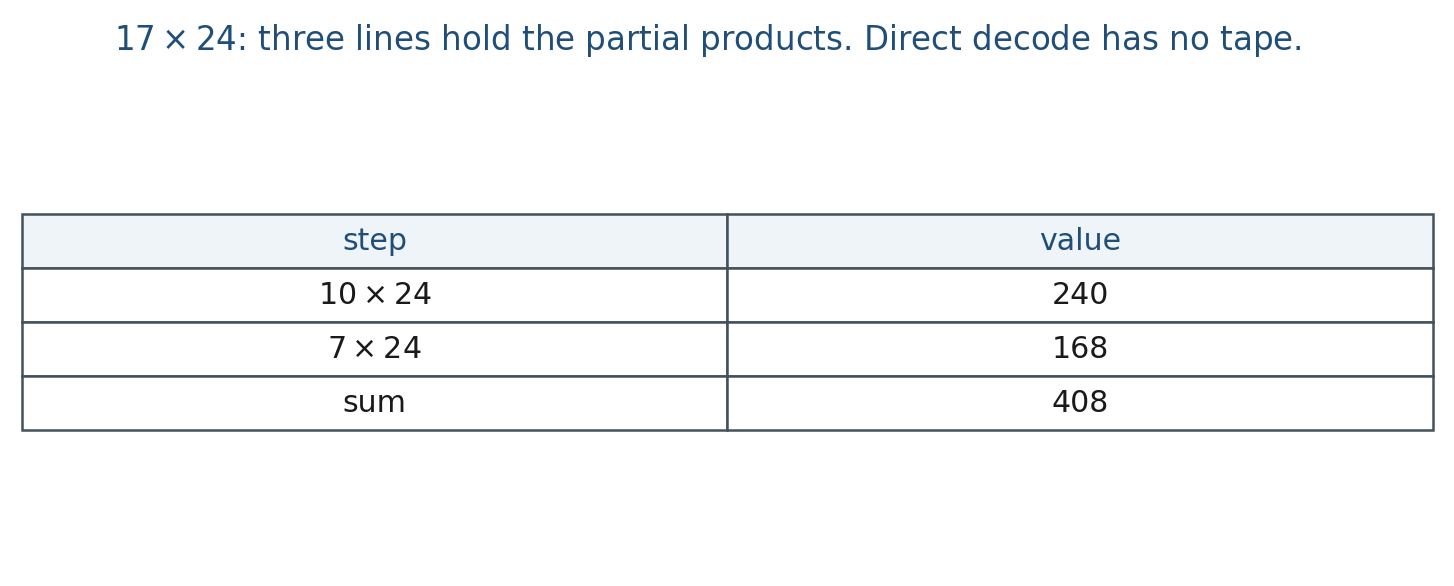
A one-hop item, “Capital of France?”, does not need hops. A CoT prompt can invent a story (“Lyon was the capital in…”) and then still say Paris—or wander to Lyon. Extra decode is extra risk. That is why you report answer accuracy and, separately, a trace check, not a vibe that the model “showed work.”
Lab 13’s 23+19 traces are the same algebra with smaller numbers.
10. Where students get stuck
- Calling CoT a fine-tune. It is a prompt / decoding choice unless you trained on traces.
- Scoring only the box. Wrong steps plus a lucky 408 will look like a win until note 13.3.
- Pasting few-shot examples from a different task (math shots, then a policy question) and blaming the model.
11. Video
Watch Andrej Karpathy, Intro to Large Language Models, 35:00–38:02.
Pause on System 1 vs System 2: the model gets more compute by emitting more tokens. That is extra test-time compute in classroom language. Optional nearby: 38:02–40:45 (self-improvement) is not required for this note. Notes 14.1–14.2 and 15.1 reuse this same URL at other minutes.
12. Practice
-
Why might CoT raise accuracy on a four-hop word problem and lower it on “What is the capital of France?”
-
Few-shot CoT puts examples in context. What goes wrong if those examples are a different task than the test item?
-
Name one number you would report besides final-answer accuracy if your project uses CoT.
-
Write a three-line CoT for that ends in 408. Then write one line that is CoT-shaped but computes and boxes 408. Which is unfaithful?
-
Direct prompt, temperature , one sample: accuracy . CoT, temperature , one sample: accuracy , mean tokens longer. What two numbers belong in the table besides ?