
6.2 Audio Encoders and Speech Models
Whisper transcribes (GPT-style decoder, no CTC). CLAP retrieves. Same spectrogram, different head.
These notes match the lecture slides. Use (slides) on the course hub for the deck.
Two audio systems you will cite: Whisper transcribes (encoder–decoder), CLAP retrieves (two towers, like CLIP). Same spectrogram tokens, different heads. Whisper takes log-mel in, two convs, a transformer encoder, a GPT-style decoder, 30-second chunks, and no CTC. If someone says “both take spectrograms so they are the same,” point at the head.
1. What Whisper and CLAP are
Whisper transcribes speech. CLAP retrieves audio against text. Same spectrogram, different head.
Whisper (Radford et al., 2022) is an encoder on audio tokens plus a GPT-style decoder that writes text. There is no CTC loss in this course’s picture. The encoder is a transformer on log-mel spectrogram patches (note 6.1). Encoder input is the log-mel plus two convolutional layers, then positional embeddings, then standard transformer blocks. The decoder is causal and cross-attends to the encoder, like translation in note 3.3.
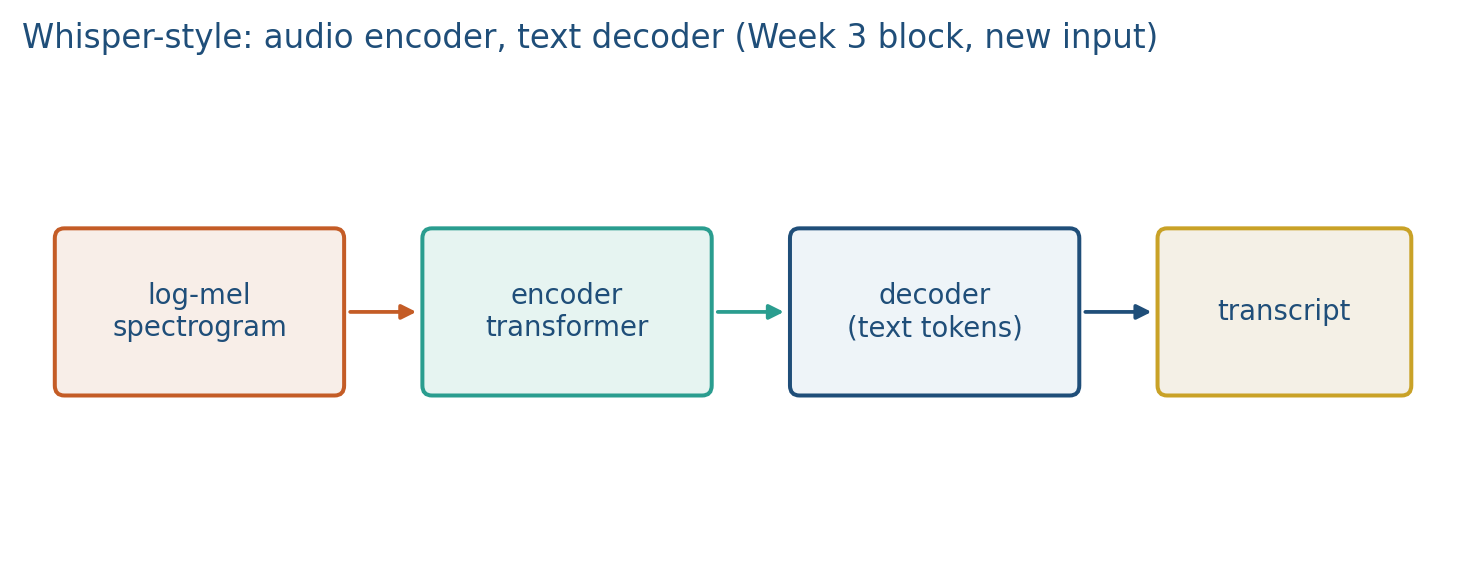
The output is text, plus special tokens for language, timestamps, and task (transcribe versus translate).
CLAP (Contrastive Language–Audio Pretraining) is coordinated, not joint. An audio encoder (CNN or transformer on the spectrogram) and a text encoder emit vectors in one space. InfoNCE on audio–caption pairs. After training you keep both towers. It is CLIP with sound instead of pixels.
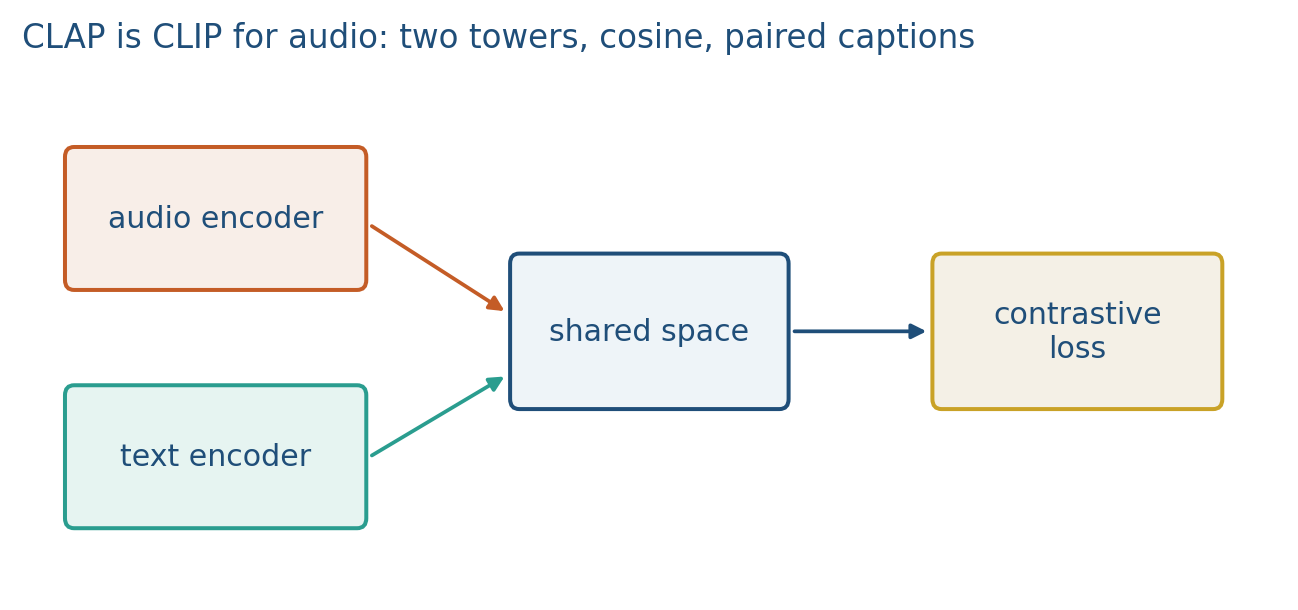
Zero-shot tagging: encode "a dog barking", rank clips by cosine. Retrieval both ways. It is not a transcriber. If you need words, use Whisper (or a CTC ASR). If you need “find the clip that matches this sentence,” use CLAP.
2. Why we use it
ASR needs a decoder. Retrieval needs a score. Do not use Whisper as a search index or CLAP as a transcriber.
Whisper’s pretraining is weakly supervised: a huge pile of audio paired with transcripts from the web, filtered rather than hand-labeled (on the order of 680{,}000 hours). Multilingual is the point. You do not train this from scratch in the lab; you would load a checkpoint. The architecture is what you need to draw.
CLAP exists because a transcript is the wrong object for search. A gallery of podcast clips plus a typed query wants a cosine, not a decoder. The text tower can be bidirectional (BERT-style) because you encode a whole caption as one vector. Whisper’s decoder is causal because it emits tokens left to right.
Fusing audio with vision or text is next (note 6.3). Do not concatenate a Whisper hidden state into CLIP and call it a paper; say how you aligned the rates and the losses.
3. Architecture
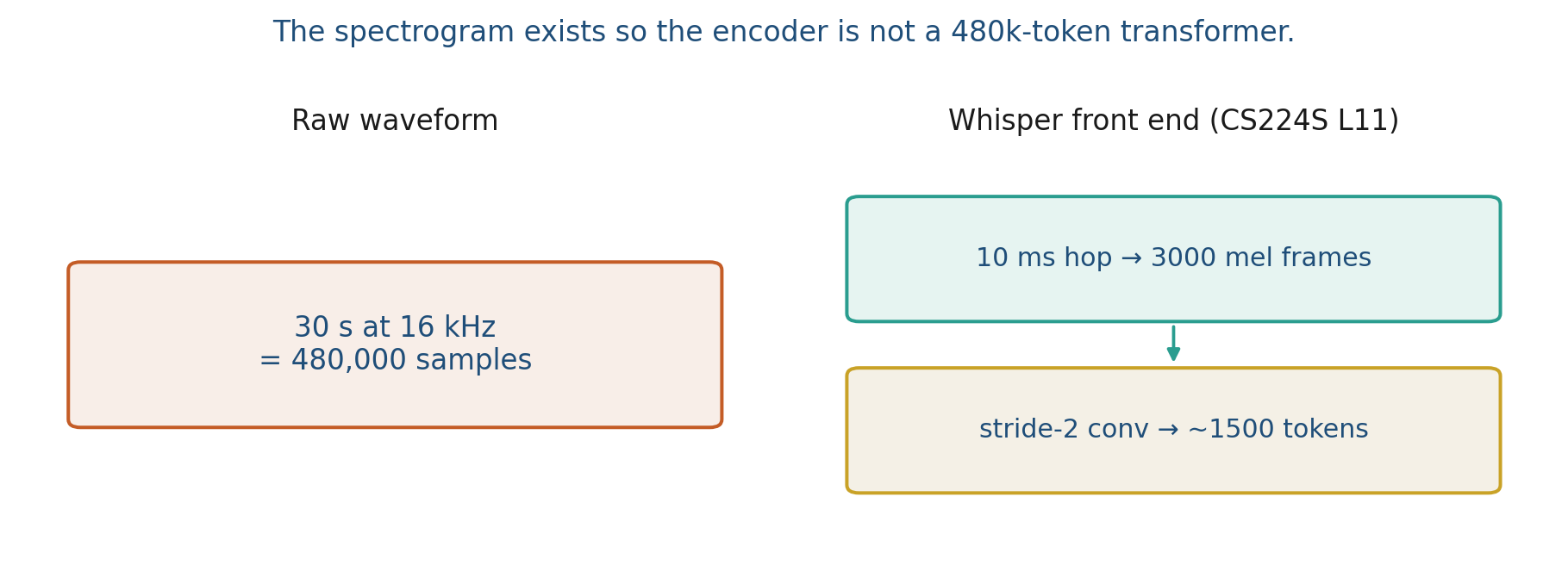
Whisper. Spectrogram, then conv/embed, then encoder blocks, then a decoder with cross-attention. Default front end: 25 ms windows, 10 ms hop, 80 mel bins, 30-second chunks. Thirty seconds at a 10 ms hop is 3000 frames before conv downsampling. The decoder never sees raw samples; it sees encoder states.
Draw the two arrows: encoder self-attention over time–frequency tokens, decoder causal self-attention plus cross-attention into those states. That is the same picture as translation (note 3.3), with a spectrogram instead of a source sentence.
Long-form audio: Whisper only sees 30 s at a time. Timestamp tokens tell it when to shift the window. That is a product detail, not a new architecture.
CLAP. Audio encoder , text encoder , cosine. InfoNCE on a batch of pairs is the CLIP loss from note 4.3: one audio vector per clip, one text vector per caption, a cosine matrix, positives on the diagonal. After training you throw away the matrix and keep the two encoders.
4. How it works, step by step
Whisper.
- Cut audio into 30 s chunks. Compute log-mel (80 bands, 25 ms window, 10 ms hop).
- Two convolutional layers downsample time; then the encoder attends over those tokens.
- The decoder is teacher-forced on transcripts, special tokens included (
<|transcribe|>, language, timestamps). Loss is next-token, conditioned on the encoder. No CTC. - At test, generate text. Timestamp tokens are just more vocabulary; they are not a separate model.
CLAP.
- Encode a batch of audio–caption pairs.
- Fill the cosine matrix. InfoNCE wants the diagonal.
- Keep both towers. Rank clips by cosine to a query string, or captions by cosine to a clip.
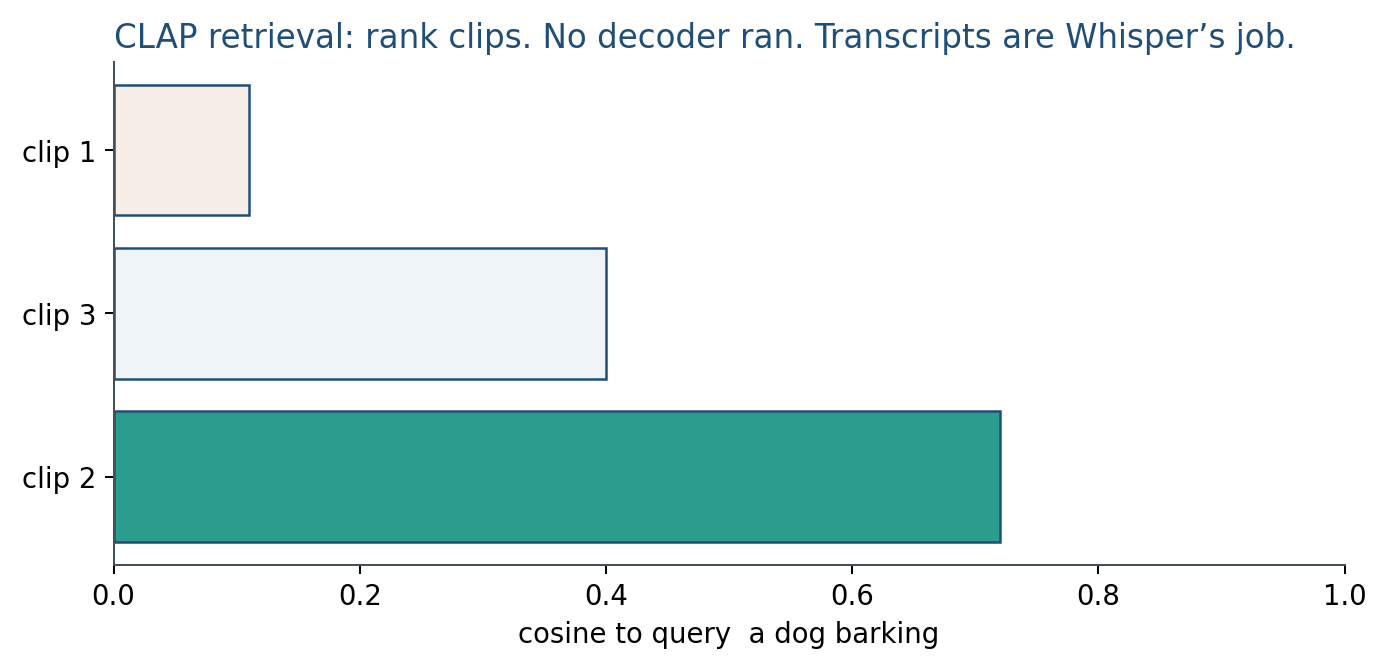
- No decoder ran. If the user wanted a transcript of the top clip, you would call Whisper on the waveform, not on the audio embedding.
5. Mathematical formulas
Whisper’s decoder is a language model conditioned on audio encoder states:
CLAP scores a clip and a text with the same cosine as CLIP:
A 30 s chunk at a 10 ms hop is mel frames. After a stride-2 conv stem you are on the order of 1500 encoder time-steps, not waveform samples. That is why the spectrogram exists.
6. Positive points and negative points
Positive.
- Whisper is a generator: transcripts, subtitles, timestamps from one decoder.
- CLAP is cheap retrieval and zero-shot tags without decoding words.
- Same spectrogram front end (note 6.1); the head is the task.
Negative.
- Whisper is not a general audio tagger and is a poor search index.
- CLAP does not decode words; a high cosine is not a transcript.
- Paired audio–text is scarce (note 6.3).
- Stuffing Whisper encoder states into a CLIP image slot without resampling time ignores the 10 ms frame rate.
When not to. Do not call CLAP a speech-to-text model because both take spectrograms. Do not assume Whisper still uses CTC.
7. Which one in a project
| Need | Model |
|---|---|
| Transcript, subtitles, timestamps | Whisper |
| Search / zero-shot tags / audio–text retrieval | CLAP |
| Generate a caption in free text | a decoder with an audio encoder (Whisper-like, or a BLIP-style audio LM) |
You should leave the hour able to pick Whisper vs CLAP without hedging. If someone says “both take spectrograms so they are the same,” stop and point at the head: causal decoder vs a cosine.
8. Teaching this note
About 30–35 minutes at the board: draw the Whisper encoder–decoder (cross-attention arrows, 30 s chunk, special tokens), then the CLAP two-tower picture, then fill the table with a project prompt from the room. Play the Whisper video in full (~5–12 min). This is not Lab 6; the lab stays on a sine STFT and toy fusion.
Board order: (1) 30 s 3000 frames, (2) decoder special tokens and “no CTC,” (3) CLAP cosine rank, (4) “which model for this app?”
9. Worked example
Whisper chunk: 30 s, hop 10 ms mel frames, 80 bands. After a stride-2 conv (as in the paper’s stem, two convs), you are on the order of 1500 encoder time-steps, not 30 s 16 kHz waveform samples. That is why the spectrogram exists.
Decoder: special token <|transcribe|> then English text. The loss is next-token on those text tokens, conditioned on the encoder. Timestamp tokens are just more vocabulary; they are not a separate model.
CLAP retrieval: three clips with audio embeddings and a query text . Cosines . Rank is clip 2, then 3, then 1. No decoder ran. If the user wanted a transcript of clip 2, you would call Whisper on the waveform, not on .
10. Where students get stuck
- Calling CLAP a “speech-to-text model” because both take spectrograms. The head is the task.
- Forgetting Whisper’s decoder is causal and CLAP’s text tower need not be.
- Stuffing Whisper encoder states into a CLIP image slot without resampling time. Rates (10 ms frames vs patch tokens) have to be named.
- Assuming Whisper still uses CTC. Whisper’s decoder is GPT-2 style; there is no CTC.
11. Video
What's AI — OpenAI's Whisper Model Explained. Play 0:00–end. Pause on the encoder–decoder sketch and on the 30-second chunk. CLAP is the board comparison; this clip is Whisper only.
12. Practice
-
Whisper’s decoder is causal. Why can CLAP’s text tower be bidirectional like BERT?
-
You have a gallery of podcast clips and a typed query. Whisper or CLAP? Why?
-
Name one special token Whisper uses that CLIP never needed.
-
A 10 s clip, 10 ms hop, 80 mel bins, no extra pooling. How many time frames hit the encoder? If you then cut non-overlapping 2-frame patches along time only, how many patch tokens?
-
Two captions score and cosine against one clip. You want words that were actually spoken. Which model, and what does the number not tell you?