
8.1 Loopy Recurrent Neural Networks
A hidden state that reads the text one token at a time.
These notes walk through the lecture slides. The original deck is unchanged; use (slides) on the course hub if you want that PDF.
1. Networks without memory
A dense net and a CNN see an input, emit an output, and forget. Nothing is stored between examples, and (in a plain CNN) nothing is stored between distant tokens except what a fixed window can cover.
Reading is not like that. You hold what came earlier and update it. Recurrent neural networks (RNNs) do the same: they keep a state and revise it at every token.
Chollet’s picture: biological systems process a stream and maintain an internal model. An RNN is the engineering version of that idea, not a model of a brain.
Sources: Practical Natural Language Processing, Natural Language Processing in Action, and Voita’s notes. StatQuest’s RNN video is a useful watch.
2. The cell
At step the cell receives
- a new input (usually a token embedding), and
- the previous state .
It emits a new state that is supposed to hold both. That state is the input to the next step.
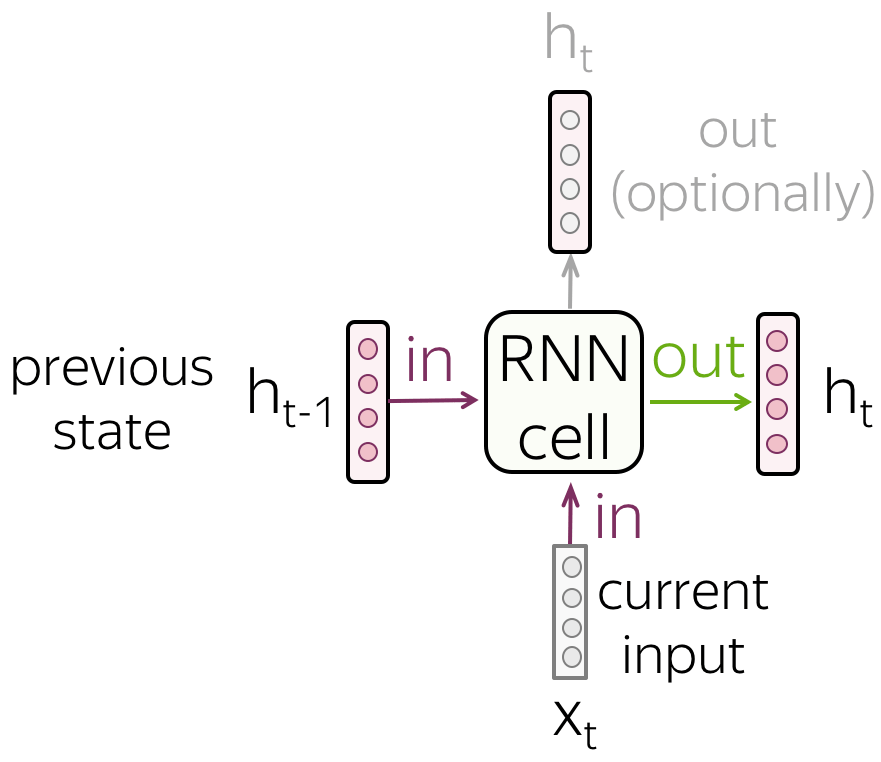
The state is reset between independent sequences (two reviews in a batch). Each review is still one data point. What changed is that the net loops inside that data point.
Unrolled in time, the same weights appear at every step. That is weight sharing along the sequence, analogous to a CNN’s shared filter, but the path is a chain, not a slide.
3. Vanilla RNN
The simplest cell is a linear mix plus :
(Lecture writes for the input map. Same idea.)
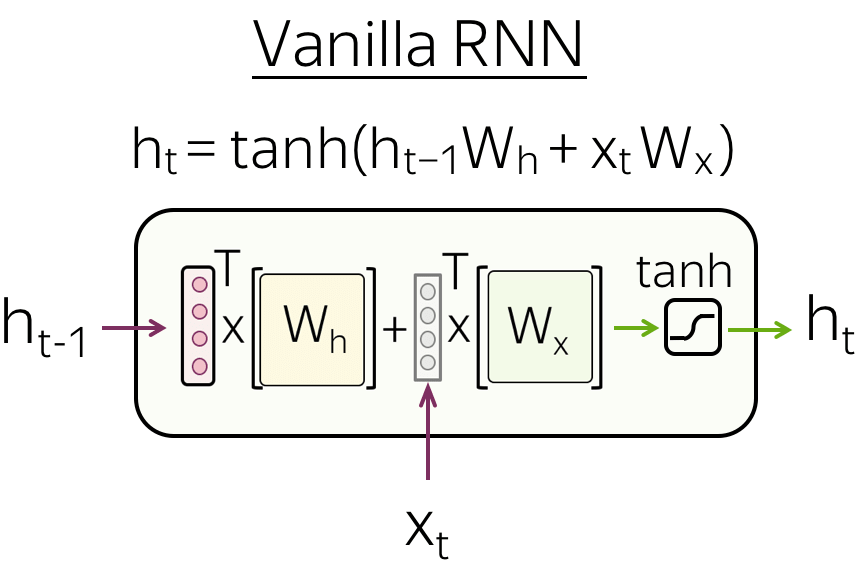
Vanishing and exploding gradients. Backprop through twenty steps multiplies twenty Jacobians. The signal to early tokens dies or blows up. Vanilla cells struggle on long reviews.
LSTM and GRU add gates: learned valves that decide what to keep, write, and forget. They do not remove the problem; they make long-range training feasible. This course will treat them as drop-in cells with the same loop around them.
4. Runtime, GPUs, and unrolling
A tiny RNN is a chain of small matrix multiplies inside a for loop. That chain does not parallelize well. On a multicore CPU it can beat a GPU. A large recurrent layer can use a GPU.
In Keras, default LSTM / GRU on GPU call cuDNN. Those kernels are fast and rigid. Recurrent dropout is not in the default kernel; Keras falls back to a slower TensorFlow implementation with the same math.
If you cannot use cuDNN, unrolling the loop (write the steps into the graph) can help the compiler. It also makes the graph huge. Use it when sequences are short and you have measured a benefit.
None of this changes the math. It changes whether the lab finishes before the session ends.
5. What this note is not
This is not yet a classifier. You have a sequence of states . Note 8.2 says which state(s) you turn into a document label: last state, stacked layers, or a bidirectional pair.
Do not use a vanilla RNN as your first production model. Use LSTM/GRU, or skip to a transformer later in the course. Do use this note to explain why a loop exists.
Unroll once on paper. Three tokens , start from . Compute , then , then with the same . The classifier in note 8.2 will sit on (or on a bidirectional pair). If you cannot do that by hand for , the Keras layer will stay a black box.
6. CNN versus RNN, one line
A CNN looks at a fixed neighborhood at every position, in parallel. An RNN looks at everything so far, in order, and cannot be fully parallelized across time. That is the accuracy / speed tradeoff you are choosing.
7. Practice
-
A CNN kernel of size 5 and a vanilla RNN both read a 40-token sentence. Which one can, in principle, mix token 1 with token 40 in a single representation, and how?
-
Why do we reset between two training documents?
-
You add recurrent dropout to an LSTM on a GPU and training becomes much slower. What happened?